The Excavated Museum

'The Museum Experience at the Mall'

the Yamuna Project

'A Lexicon of Power, Grace, Equality –
Taking Rural Indian Clay Pottery (Ceramics),
Local to Global, with International brands.'

an outreach into unconventional spaces

by

Manav Gupta

A Travelling Museum Laboratory of Terracotta

First of it’s kind Global Public Art Project on Sustainability

Hosted by

DLF

Mall of India

NCR, India 201301

Yamuna Waterfront

Dimensions: 15 ft x 20 ft x 50 ft

Time Machine - hourglass

Dimensions: 10 ft x 6 ft x 6 ft

Meet me by the riverside - the bed of Love

Dimensions: 10 ft x 6 ft x 10 ft

the beehive garden project

Dimensions: 8 ft x 15 ft x 8 ft

Noah's Ark

Dimensions: 10 ft x 6 ft x 6 ft

Taking Art beyond Art

Conceptualised and curated by Manav Gupta, the Dialogues at the Waterfront series is a collection of interdisciplinary practices, thought experiments, dialogues and performance-art earthen lamps concerts, where the artwork becomes a bedrock of activity for all stakeholders of society.

Panel Discussions

Performances

Meditation

What People Are Saying

Making

Prosaic can be Luxury

Making

‘Water and all five elements of nature are our source of sustainance. Ancient civilisations from India to the world over respected and understood this sanctity. While they drew nourishment from the great rivers. Be it our sacred Ganga or the Mississippi. As we grow, its time, we excavate the ancient philosophy of sustainable living. And we are all clay. Dust to dust. My art seeks to submit to this paradigm. Hence Excavations in Hymns of Clay.

The Time Machine – Hourglass

“As a glittering witness to each day and night of our lives. Within all the madness and beauty, while seeking, wandering from dust to dust, truth unfolds. And before we realise, we are but minuscule quartz moments fulling our clay cups along the gigantic dial of infinity, it’s Time!”

- Manav Gupta

Meet me by the riverside, the bed of love

“As a glittering witness to each day and night of our lives. Within all the madness and beauty, while seeking, wandering from dust to dust, truth unfolds. And before we realise, we are but minuscule quartz moments fulling our clay cups along the gigantic dial of infinity, it’s Time!”

- Manav Gupta

the Beehive Garden project

"Bees are an obvious or not so obvious link in the evolution chain and our sustainability. This global beehive garden project is an environmental statement by the artist about biodiversity and its crucial linkages to sustainable development. Manav’s art has always sought to play a bigger role than itself, in creating greater awareness on environemnt. And it reaches our senses and homes as a captivating reminder with its innovative deploying of “chilams” (earthen rural cigars) and “kullars” earthen cups to create beehives that can occupy every garden and home that keep acting as a gentle creative reminder to us each day to stop a while… and while doing what we are doing, try and add a drop in the ocean in the preservation of bees and biodiversity."

- Manav Gupta

Dialogues at the Waterfront

‘Water and all five elements of nature are our source of sustainance. Ancient civilisations from India to the world over respected and understood this sanctity. While they drew nourishment from the great rivers. Be it our sacred Ganga or the Mississippi. As we grow, its time, we excavate the ancient philosophy of sustainable living. And we are all clay. Dust to dust. My art seeks to submit to this paradigm. Hence Excavations in Hymns of Clay.

(L - R) Ms Subha Rajan, Director CII | Dr Yogendra Narain, Former Secretary General, Rajya Sabha (Parliament of India) | Mr N. P. Singh, District Magistrate, Gautam Buddha Nagar, | Ms Usha Malik, Eminent Scholar | Pratibha Prahlad, Eminent Dancer, Educator, Author | Mr Shibli Khan, Vice President, DLF, Mall of India.

Dr Yogendra Narain, Former Chief Secretary of Uttar Pradesh, Secretary General Raja Sabha

Ms Subha Rajan, Director CII

Mr N. P. Singh, District Magistrate, Gautam Buddha Nagar

What People are Saying

Mr Sandy Angus

Chairman, Angus Montgomery

Mr Sumit Awasthy

Senior Journalist, Primetime News Anchor

Jacqueline Lundquist

Former First Lady, United States Ambassador to India

Press

Jan 25, 2017 | Times Of India | E Times | Clay lamps and kulhads turn Noida mall into an art museum.

28 Jan, 2017 | Times of India | Uma Nair | The Excavated Museum’ – Manav Gupta is truly a unique genius – the thinker and the visionary is hailed by critics as one of the most erudite and versatile contemporary artists today.

Jan 29, 2017 | Millenium Post | Excavated Museum at the Mall Millennium Post explores why this solo public art project by any artist is a solo biennale in itself. A list of many firsts.

Feb 17, 2017 Amar Ujala | Manav Gupta Excavated Museum At Dlf Mall Noida.

Feb 14, 2017 | Life & More  Celebrated artist Manav Gupta has set up a one-of-its kind travelling museum.

17th feb 2017 नदियों की संस्कृतियों को जोड़ने में लगा ये आर्टिस्ट, चाक मिट्टी का देखिए कमाल  भारत के टॉप टेन आर्टिस्ट में शुमार मानव गुप्ता ने पॉटरी आर्ट के जरिए संस्कृतियों को जोड़ने का बेहतरीन प्रयोग किया है। उन्होंने भारतीय संस्कृति की वाहक गंगा को चाक मिट्टी की कला के जरिए दुनिया की दूसरी नदियों से जोड़ने का रचनात्मक बीड़ा उठाया है, जिसकी तारीफ चारों ओर हो रही है।

28th Feb 2017 | मिट्टी के कुल्हड़ और चिलम से नोएडा में बही ‘गंगा’  Pottery Art Presentation By Manav Gupta Catches Eyeballs In Noida DLF Mall.

September 13, 2017 | Women Economic Forum New Delhi, India  The ARTH Project  Jan-17  Manav Gupta- The travelling museum at DLF mall of India.

April 17, 2017 | Sankalp Pravah, Prime Minister’s initiative inaugural ceremony by min of culture.

Jan 19, 2017 | Dlf invite Dlf invite.

March 4th 2017 | He is the next big thing in art, an Outlook magazine article says. Times of India calls him one of India’s most erudite and versatile contemporary artists.

His works have been featured in the Bible of art, Blouin Art Info. With four entries in Limca Book of Records, he is listed by Financial Times as one of the ten contemporary artists from India whose works will fetch good returns. This, even as BBC hails his latest project.

Feb 21, 2017 | The Daily Pioneer | Priyanka Joshi | The little clay pot Artist Manav Gupta uses the most basic terracotta items in our everyday inventory and mounts an installation at a mall to convey his message of ecological sustainability.

Mar 2, 2017  Times of India | Niharika Lal | Clay installation at Noida mall gets an extended display.

Dec 05, 2017 Twitter Amitabh Kant | Greatly enjoyed this wonderful exhibition “Excavations in hymns of clay” by artist Manav Gupta. Extremely creative!

January 29, 2017 | Millennium Post | Excavated Museum at the Mall | Millennium Post explores why this solo public art project by any artist is a solo biennale in itself.

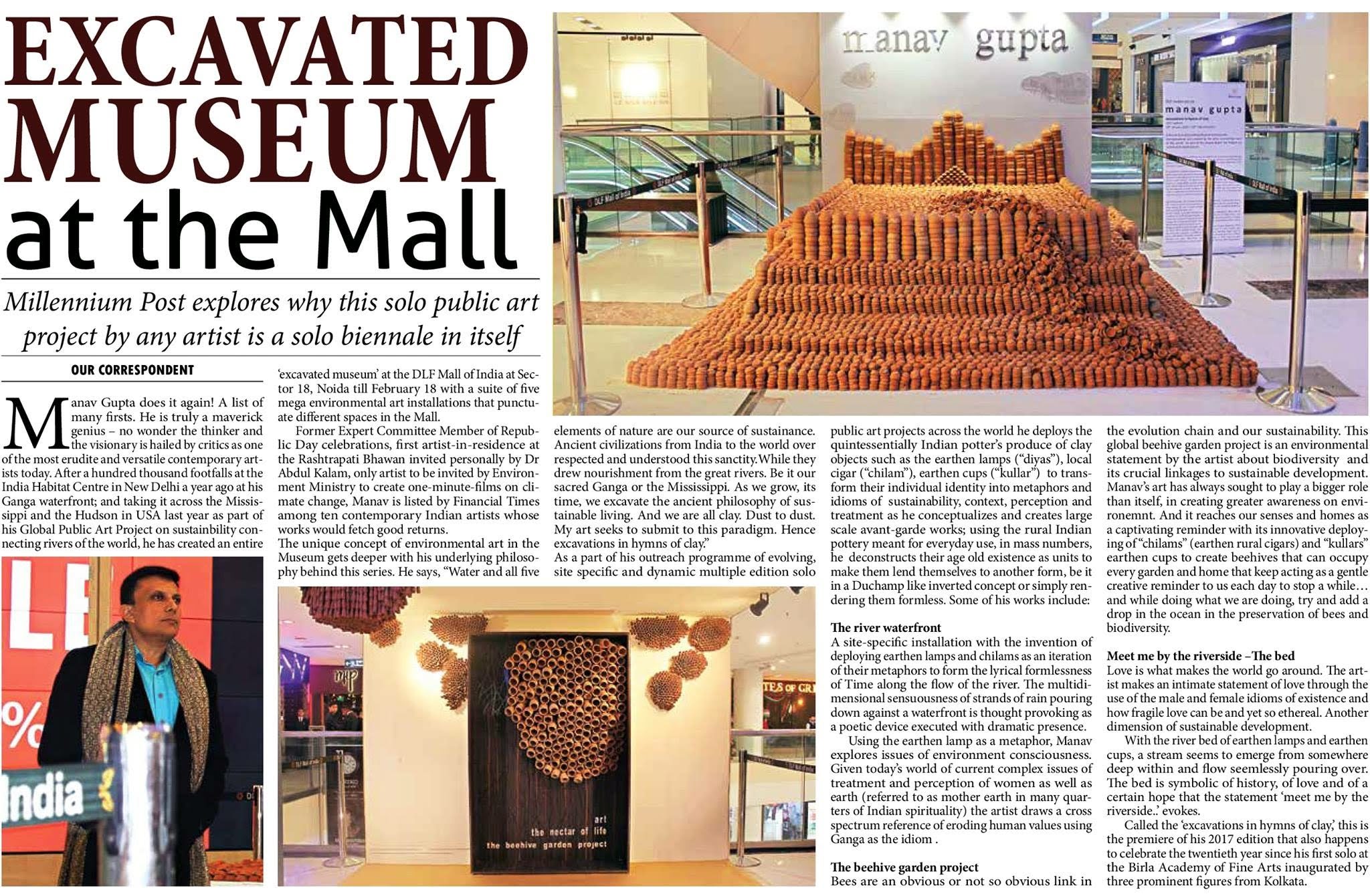
Manav Gupta does it again! A list of many firsts. He is truly a maverick genius – no wonder the thinker and the visionary is hailed by critics as one of the most erudite and versatile contemporary artists today. After a hundred thousand footfalls at the India Habitat Centre in New Delhi a year ago at his Ganga waterfront; and taking it across the Mississippi and the Hudson in USA last year as part of his Global Public Art Project on sustainbility connecting rivers of the world, he has created an entire ‘excavated museum’ at the DLF Mall of India at Sector 18, Noida till February 18 with a suite of five mega environmental art installations that punctuate different spaces in the Mall.

Former Expert Committee Member of Republic Day celebrations, first artist-in-residence at the Rashtrapati Bhawan invited personally by Dr Abdul Kalam, only artist to be invited by Environment Ministry to create one-minute-films on climate change, Manav is listed by Financial Times among ten contemporary Indian artists whose works would fetch good returns. The unique concept of environmental art in the Museum gets deeper with his underlying philosophy behind this series. He says, “Water and all five elements of nature are our source of sustainance. Ancient civilizations from India to the world over respected and understood this sanctity.While they drew nourishment from the great rivers. Be it our sacred Ganga or the Mississippi. As we grow, its time, we excavate the ancient philosophy of sustainable living. And we are all clay. Dust to dust. My art seeks to submit to this paradigm. Hence excavations in hymns of clay.”

As a part of his outreach programme of evolving, site specific and dynamic multiple edition solo public art projects across the world he deploys the quintessentially Indian potter’s produce of clay objects such as the earthen lamps (“diyas”), local cigar (“chilam”), earthen cups (“kullar”) to transform their individual identity into metaphors and idioms of sustainability, context, perception and treatment as he conceptualizes and creates large scale avant-garde works; using the rural Indian pottery meant for everyday use, in mass numbers, he deconstructs their age old existence as units to make them lend themselves to another form, be it in a Duchamp like inverted concept or simply rendering them formless. Some of his works include:

The River Waterfront
A site-specific installation with the invention of deploying earthen lamps and chilams as an iteration of their metaphors to form the lyrical formlessness of Time along the flow of the river. The multidimensional sensuousness of strands of rain pouring down against a waterfront is thought provoking as a poetic device executed with dramatic presence. Using the earthen lamp as a metaphor, Manav explores issues of environment consciousness. Given today’s world of current complex issues of treatment and perception of women as well as earth (referred to as mother earth in many quarters of Indian spirituality) the artist draws a cross spectrum reference of eroding human values using Ganga as the idiom.

The Beehive Garden project
Bees are an obvious or not so obvious link in the evolution chain and our sustainability. This global beehive garden project is an environmental statement by the artist about biodiversity and its crucial linkages to sustainable development. Manav’s art has always sought to play a bigger role than itself, in creating greater awareness on environemnt. And it reaches our senses and homes as a captivating reminder with its innovative deploying of “chilams” (earthen rural cigars) and “kullars” earthen cups to create beehives that can occupy every garden and home that keep acting as a gentle creative reminder to us each day to stop a while… and while doing what we are doing, try and add a drop in the ocean in the preservation of bees and biodiversity.

Meet me by the riverside –The bed
Love is what makes the world go around. The artist makes an intimate statement of love through the use of the male and female idioms of existence and how fragile love can be and yet so ethereal. Another dimension of sustainable development. With the river bed of earthen lamps and earthen cups, a stream seems to emerge from somewhere deep within and flow seemlessly pouring over. The bed is symbolic of history, of love and of a certain hope that the statement ‘meet me by the riverside..’ evokes. Called the ‘excavations in hymns of clay,’ this is the premiere of his 2017 edition that also happens to celebrate the twentieth year since his first solo at the Birla Academy of Fine Arts inaugurated by three prominent figures from Kolkata.

January 31, 2017 | Times of India | The Excavated Museum - Manav Gupta

By Uma Nair, Art Critic and Historian

Manav Gupta is truly a unique genius – the thinker and the visionary is hailed by critics as one of the most erudite and versatile contemporary artists today. After a hundred thousand footfalls at the India Habitat Centre in New Delhi a year ago at his Ganga waterfront; and taking it across the Mississippi and the Hudson in USA last year as part of his Global Public Art Project on sustainbility connecting rivers of the world, he has created an entire ‘excavated museum’ at the DLF Mall of India at Sector 18, Noida till the 18th Feb 2017 with a suite of five mega environmental art installations that punctuate different spaces in the Mall.Why ‘excavations in hymns of clay’ ? His phiolsophy and artist statement bring out the uniqueness behind the whole first of its kind concept of a solo project of environmental art by any artist as a travelling museum and public art for sustainable development. He says ‘Water and all five elements of nature are our source of sustenance. Ancient civilizations from India to the world over respected and understood this sanctity. While they drew nourishment from the great rivers. Be it our sacred Ganga or the Mississippi. As we grow, its time, we excavate the ancient philosophy of sustainable living. And we are all clay. Dust to dust. My art seeks to submit to this paradigm. Hence ‘excavations in hymns of clay. ‘As a part of his outreach programme of evolving, site specific and dynamic multiple edition solo public art projects across the world he deploys the quintessentially Indian potter’s produce of clay objects such as the earthen lamps (“diyas”), local cigar (“chilam”), earthen cups (“kullar”) to transform their individual identity into metaphors and idioms of sustainability, context, perception and treatment as he conceptualizes and creates large scale avant-garde works; using the rural Indian pottery meant for everyday use, in mass numbers, he deconstructs their age old existence as units to make them lend themselves to another form, be it in a Duchamp like inverted concept or simply rendering them formless.

The River Waterfront

A site-specific installation with the invention of deploying earthen lamps and chilams as an iteration of their metaphors to form the lyrical formlessness of Time along the flow of the river. The multidimensional sensuousness of strands of rain pouring down against a waterfront is thought provoking as a poetic device executed with dramatic presence.

Using the earthen lamp as a metaphor, Manav explores issues of environment consciousness. And also how perception and context interplay each other. The earthen lamp is woven in the cultural-religious fabric of India from time immemorial. And the chilam a means of cheap intoxication to gratify. This humble small clay bowl and the local “cigar” have a nondescript existence and only during that momentary use turn into the medium of gratifying the desires of the soul or the senses. Taken for granted. Anointed when needed. Only revered when in use. Their life is strange Like the Ganges.

Given today’s world of current complex issues of treatment and perception of women as well as earth (referred to as mother earth in many quarters of Indian spirituality) the artist draws a cross spectrum reference of eroding human values using Ganga as the idiom. The pollution of the rivers, the shrinking of water and its availability and such other climate change issues have been in the artist’s ethos of work since beginning. This laying of the river along the banks of the Yamuna at the Mall of India is the artist’s bedrock of opportunity for dialogues across different stake holders of society and cross cultural worlds.

The Time Machine

With the first of its kind use of the potter’s produce of earthen cups to form the hourglass; the artist engages the audience with Time and its ethereal and transient passage. Clay, a naked, earth symbol of existence, resource and sustainability and the cup as the metaphor of Time’s limitedness draw us to explore how we use our resources. The fragility of clay juxtaposed with the limitedness of the “cup of Time” draw an engagement to our waste, perception, passage and interface with Time and Life itself in a rapidly mechanized, capitalistic,

consumerist human interaction with earth along our limited timelines of life.

The introduction of Light within, by the artist, celebrates the awakening of our consciousness and its potential of Hope.This sculpture – installation is philosophical and spiritual, teasing subtle nuances of human intelligence and its emotional quotient on one plane, while at the same time, simple, elegant graceful and celebrating the public engagement with art itself – the exciting possibilities of the potters produce as evolved artistic practice made brilliantly simple by the artist for mass consumption.

Noah’s Ark

The artist uses the symbolism of the Noah’s ark to underline the relevance of saving the world. A cycle of creation, un-creation, and re- creation, in which the ark plays a pivotal role.Noah’s ark is the artist’s imagination of an ancient civilisation in which Noah and his boat were etched in history for saving life on earth from doomsday. The artist excavates his impression of how a buried museum might be discovered that houses the Noah’s Ark and the Time Machine and other such creations that hold secrets of sustainable living and how each one of us need to play a role in saving the wrath of Nature if we keep tampering with it.We are all clay and could all be the Noah to stop a while and protect our own; by adopting a safe methodology of sustianble living that takes the future generations of our own families and other species to an evolved and secure life through the consciousness of preserving our environment.

The beehive garden project

 Bees are an obvious or not so obvious link in the evolution chain and our sustainability. This global beehive garden project is an environmental statement by the artist about biodiversity and its crucial linkages to sustainable development. Manav’s art has always sought to play a bigger role than itself, in creating greater awareness on environment. And it reaches our senses and homes as a captivating reminder with its innovative deploying of “chilams” (earthen rural cigars) and “kullars” earthen cups to create beehives that can occupy every garden and home that keep acting as a gentle creative reminder to us each day to stop a while… and while doing what we are doing, try and add a drop in the ocean in the preservation of bees and biodiversity.

‘Meet me by the riverside’ The bed

Love is what makes the world go around. The artist makes an intimate statement of love through the use of the male and female idioms of existence and how fragile love can be and yet so ethereal. Another dimension of sustainable development.

With the river bed of earthen lamps and earthen cups, a stream seems to emerge from somewhere deep within and flow seemlessly pouring over. The bed is symbolic of history, of love and of a certain hope that the statement ‘meet me by the riverside..’ evokes.

February 21, 2017 | The Pioneer | The little clay pot

By Priyanka Joshi

Artist Manav Gupta uses the most basic terracotta items in our everyday inventory and mounts an installation at a mall to convey his message of ecological sustainability.

Art helps us perceive life in a different way, either through colour, form or its latent narrative. So believes artist Manav Gupta, who has redefined public art spaces in India, and hasmounted his series of terracotta installations, Hymns of Clay, at DlF Mall of India, Noida.This is the first of what he calls his travelling museum.“I want to take out art from museum and gallery spaces and make it available for everybody. let them bring in their own understanding and interpretations. This place gets a footfall of 70,000 people every day, which may not be the case with a museum. A travelling museum at a mall works as an interlude and offers an experiential.” Gupta’s clay exhibits are intended to raise awareness about our ecologically fragile times and the need for sustainability. “The exhibition is about water and the five elements of nature. I have used the most basic and functional items created by a potter since the beginning of time — earthen lamps (diyas), local cigars (chillum) and earthen cups (kulhar). At one level, these items are very personal and intimate. At another level, these vessels are used for very humble experiences. You buy them from the roadside and throw them after use. They represent how casually we treat the earth’s resources. That is the metaphor I have used to drive home the point about sustainability.”Gupta believes that all five elements of nature are our source of sustenance. He says, “Ganga is about the passage of time and that is symbolised by the hourglass, the only symbol of measuring time in the ancient past. So as we grow with time, we excavate the ancient philosophy of sustainable living. And we are all clay, very mouldable. My art seeks to submit to this paradigm.”


Flow of river (The waterfront)

“Ganga is close to my heart,” Gupta adds. In this exhibit, he uses chillum and diyas to depict the ebb and tide of life. He uses lamps because they are woven in the cultural-religious fabric of India from time immemorial while the chillum depicts cheap intoxication and sensory gratification. And life is perennially a conflict of both our higher and lower selves.

History recall (The time machine)

 In this installation, Gupta uses terracotta cups to form an hourglass. “Time Machine recalls the mechanised lives we lead without respecting sustainable living and resources. I use cups here as a symbolic measure of limited time.” The fragility of clay juxtaposed with the finite nature of the cup draws attention to our wasted perception, of our rapidly capitalistic, consumerist human interaction with earth along our limited timelines.

Love (Riverside bed)

This one is about stringing life till the end. It’s a symbol of the history of love through the use of the male and female idioms of existence and how fragile love can be and yet so ethereal. “My purpose of choosing this element is that without love we don’t exist,” says Gupta. With the river bed of earthen lamps and earthen cups, a stream seems to emerge from somewhere deep within and flow seamlessly.

Global story (The Noah’s Ark)

This is an artist’s imagination of an ancient civilization, Noah retrieving each of earth’s creations and ensuring their survival till posterity. This is Gupta’s way of saying how we should save ourselves from the wrath of nature and not tamper with it.

life Saviors (The beehive garden)

“Bees are a very important chain of our eco system; if they die, then the entire eco system collapses. This beehive garden represents India’s younger demographic. I have used chillums here to signify drug abuse which is eating into our future human resource,” adds Gupta.

Jan 25, 2017 | Times Of India | E Times | Clay lamps and kulhads turn Noida mall into an art museum

By Abhimanyu Mathur
Jan 25, 2017, 01:00 IST

Clay lamps and kulhads turn Noida mall into an art museum.

Jacqueline Lundquist (L), wife of the former US ambassador, lights a diya with Manav Gupta

It’s not every day that the interiors of a mall turn into an art museum, which is why the clay installations at DLF Mall of
India unveiled this past week drew quite a few curious glances from the shoppers. Titled ‘Excavations in Hymns of Clay’, the project saw artist Manav Gupta create art installations with clay lamps, kulhads, and chillums to form a one-of-its kind travelling museum in the mall. One of the installations in the shape of an hourglass in the Noida mall (BCCL/ Lokesh Kashyap)
The theme of the installations was rivers of the world. Manav said, “This is unique because it’s a travelling museum. These installations will travel from one place to another, culminating at an actual museum. The idea behind a travelling museum is making it accessible to maximum people.”

(L-R) Manav Gupta, Pushpa Bector, Rajan Swaroop (BCCL/ Lokesh Kashyap)

The project was unveiled by the artist along with senior officials from the mall in the presence of art lovers from NCR. Pushpa Bector, head – premium malls, DLF, said, “There hasn’t been a great history of public art projects in the NCR, but of late that has changed, which is a welcome sign. What I particularly liked about this one is that it is in a modern mall, a place where you wouldn’t expect an art installation. We are trying to make art accessible to everyone.” The
installations will be displayed in the mall till February 18, and the launch will be followed by weekend events like morning meditations, as well as dance and music collaboration

Mar 2, 2017 | Times of India | Times News Network | Clay installation at Noida mall gets an extended display

By Niharika Lal
TNN | Mar 2, 2017, 15:00 IST

Clay installation at Noida mall gets an extended display.

Noida is not quite there yet in terms of public art display, in comparison to Delhi and Gurgaon, but efforts are being made to give prominence to display of art in the city. A mall in Sector 18 had put up artist Manav Gupta’s installations made of clay, which were supposed to be on display for a limited period. But the mall authority decided to extend the period of display because of popular demand. They did host a concluding ceremony, though, with dancer Shivani Varma performing at the event. The exhibition will be on till the first week of March.

The travelling museum, called ‘Excavations In Hymns Of Clay’ is a first-of-its- kind concept of a solo project on environmental art. Manav told us, “Art doesn’t belong to galleries only, it belongs to people, and so, art should be present wherever people are. Malls get footfalls of more than thousands of people every day, and so, if exhibitions are set up in such public places, more people get to see them. Now, as the exhibition has been extended till the next month more visitors will get to see it.”

Manav Gupta

The visitors at the mall told us that they were quite impressed with the initiative. Arpana Bishnoi, who lives in Sector 22 and was at the mall, told us, “I am glad to see that art is making its way even to the malls. In Delhi, I have seen galleries and installments, but in Noida, this is a new thing. After I saw it, I returned with my granddaughter to show her the art. This is a welcome change. We hope other malls will also follow.