

The artist took over 27 acres of IGNCA campus to create the fifth edition of the first-of-its-kind ‘Travelling Museum Laboratory of Art for Earth’
Hosted by IGNCA, Ministry of Culture, Govt of India, 11, Man Singh Road, New Delhi, India
5 June 2018 – 17 December 2018.
(Extended twice by Public Demand)
Commissioned by the Ministry of Culture, Govt of India


‘arth’ (pronounced ‘earth’ ), Manav Gupta’s brainchild of two decades, draws from the Devanagri script of ‘arth’ meaning ‘wealth’ and ‘meaning’. The artist explores both, in the context of earth and its resources, as our true wealth while on this planet and urges us to ‘stop a while’ and lead a life with environment consciousness. And he does that by weaving pottery as monumental artworks that then form a bedrock of activity, for people to conglomerate and think beyond. In this movement, earthen lamps (“diyas”), local cigar (“chilam”), earthen cups (“kullar”), become metaphors and idioms of sustainability, context, perception and treatment of the rivers and waters of lands where the artist’s research and experience together form the story of ‘The River’, the ‘rain’, ‘The Beehive Garden’ and more.Finding new ways of repurposing the traditional to avant garde. Urging people to think how we live with and use water & earth’s resources.




What makes arth – art for earth unprecedented as a public art project is not only its material scale but its institutional imagination. Gupta did not install six sculptures on government lawns and invite the press. He built a living institution for five months, one that generated its own events, its own pedagogical practices, its own ritual forms, its own economy of attention.
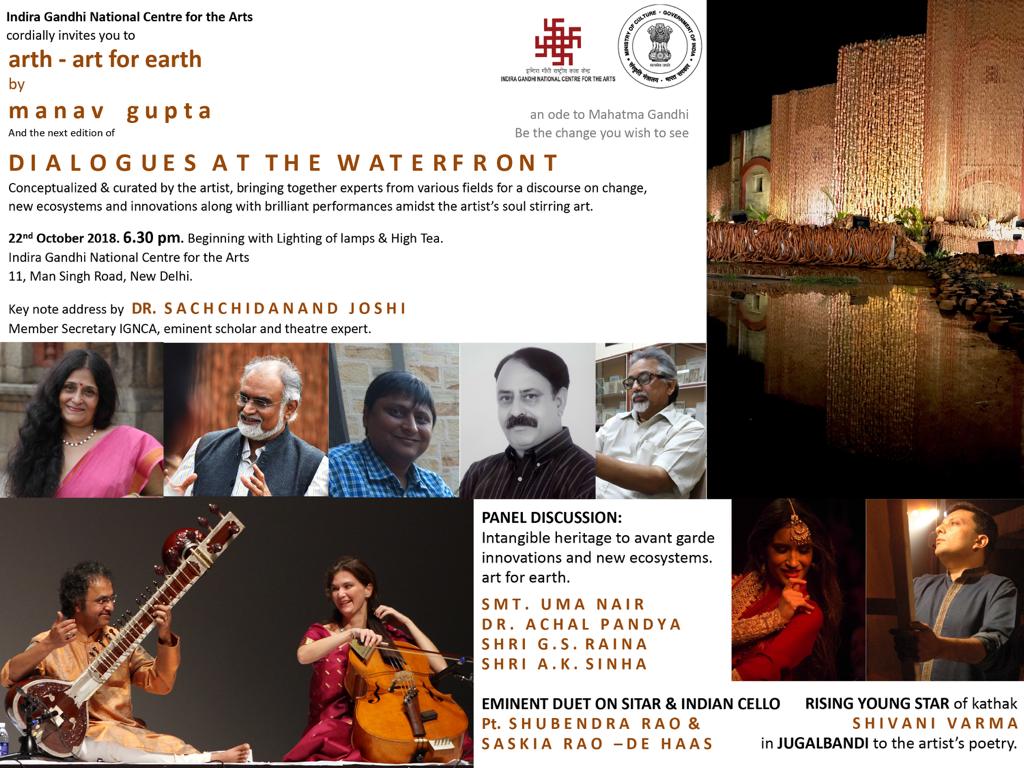
The arth festivals — held on 5 June (World Environment Day), 22 October, and 17 November — were not openings or closings in the conventional sense. They were activations: moments when the installation ceased to be a set of objects and became a social and spiritual event. Earthen lamp concerts brought together dance, music, poetry, and jugalbandi within the installation’s space, so that the performance and the sculpture were inseparable — the lamps the dancers moved among were the river, the trees the musicians sat beneath were threaded with clay rain, the air was the same air that the Neem filtered and the chillums had been shaped by.
The student arth festivals — three separate outreach events held on 22 October — introduced a pedagogical dimension that few public art projects of this ambition have ever successfully integrated. Schoolchildren walked through Rain and the Beehive Garden and sat at the Waterfront for Dialogues that were not lectures about ecology but encounters with it: a child standing inside half a million clay raindrops, understanding the water cycle not as a diagram in a textbook but as a space they could inhabit.
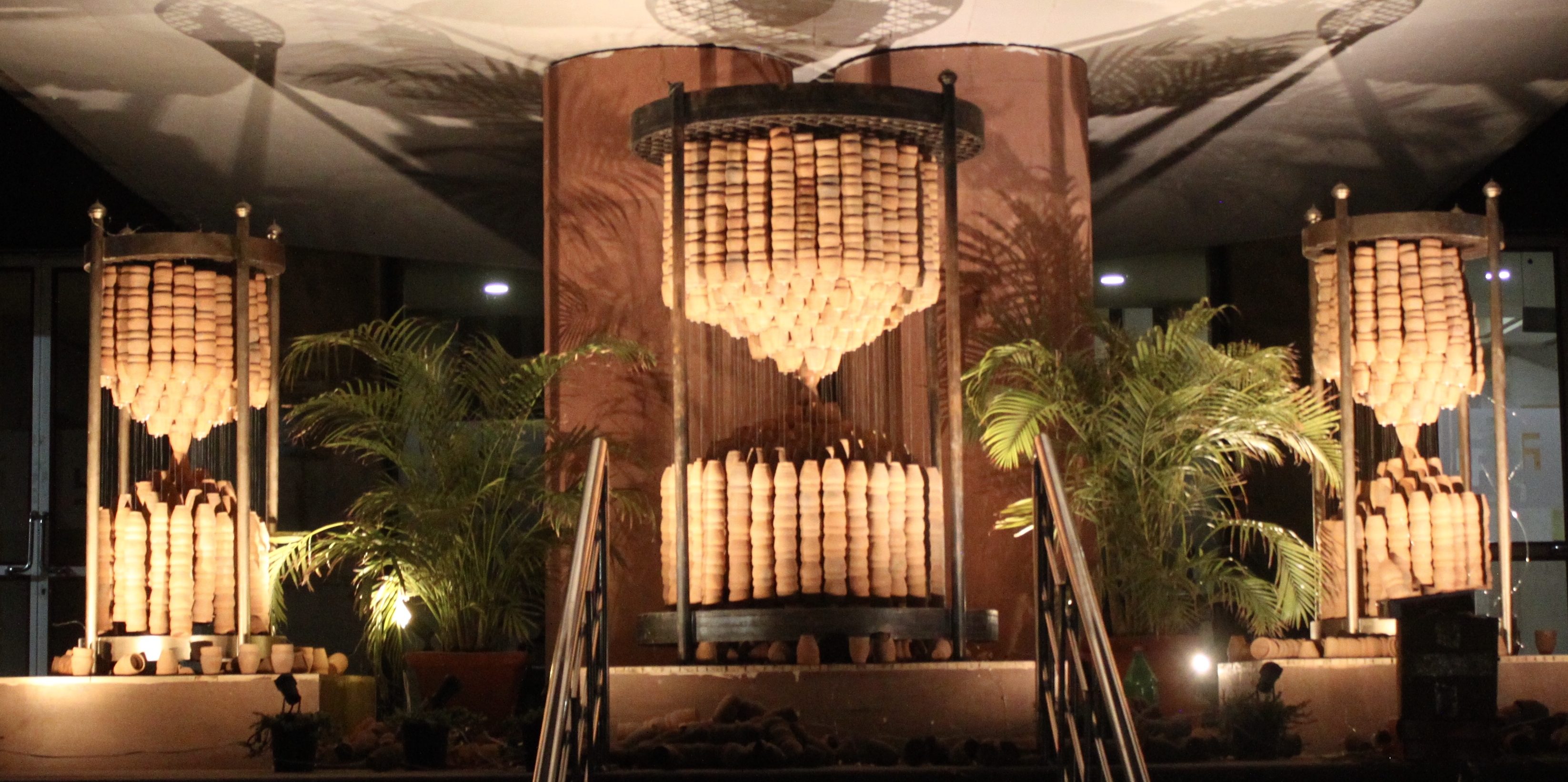
The Vedic Chanting, the Meditations, the Panel Discussions, the Lighting of Earthen Lamps at the Ganga Waterfront, the Dialogues at the Waterfront — each of these was an event layer that deepened the installation’s meaning without explaining it. The Vedic chant inside the Hourglass – Time Machine did not gloss the hourglass; it inhabited it. The earthen lamp concert at the river did not celebrate the River; it became part of it.
This is what Gupta means when he describes his practice as “taking art beyond art.” The installation is not the end point of the work. The installation is the ecology within which a multiplicity of human practices — ritual, educational, musical, contemplative, critical — can occur, and in occurring, both transform and are transformed by the clay world Gupta has built.
The installation as ecology — every practice it hosted was itself part of the work


The student arth festivals — three separate outreach events held on 22 October — introduced a pedagogical dimension that few public art projects of this ambition have ever successfully integrated. Schoolchildren walked through Rain and the Beehive Garden and sat at the Waterfront for Dialogues that were not lectures about ecology but encounters with it: a child standing inside half a million clay raindrops, understanding the water cycle not as a diagram in a textbook but as a space they could inhabit.






CEO, Niti Ayog, Government of India

President, IGNCA Trust, Ministry of Culture, Government of India

Mr Arun Goel
Secretary, Ministry of Culture, Government of India


Former Secretary, Rajya Sabha, Chief Secretary Uttar Pradesh, Govt of India


Former Director, India Habitat Centre

Scholar and Eminent Environmental Activist | Forbes 7 Most Influential Women in the World

Scholar – Vedic period, Buddhism and the Indian arts | Padma Bhushan, Member, Rajya Sabha, Ex President ICCR; Chairman, Indian Council of Historical Research


Eminent Film Director


Eminent Artist

Eminent Art Critic and Historian
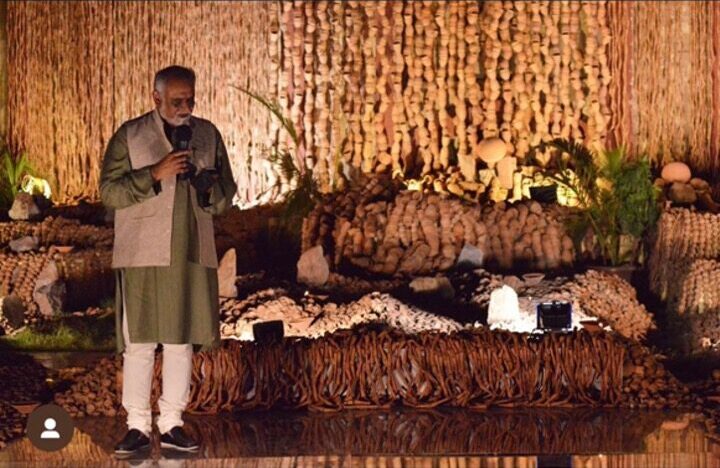
Member Secretary, Indira Gandhi National Centre for the Arts, Ministry of Culture, Government of India





25, 2018 | New India Express | Medha Dutta Yadav The Sunday Magazine I want to make art available to all.
September 24, 2018 | E Times Arth Art For Earth By Manav Gupta.
March 14, 2018 | Doordarshan National INTERVIEW You Tube Aaj Savera : An Interview With Manav Gupta : Eminent Artist And Thinker.
July 04, 2018 |National Herald | Navjeevan E Paper | India in Picture.
July 04, 2018 | Twitter Web co tweet, Minister Of Culture Government of India, Mahesh Sharma Minister Opening tomorrow: Arth-Art for Earth-The Excavated Museum of Clay by Manav Gupta July 5, 2018 7.00 pm IGNCA Lawns, 11 Mansingh Road, New Delhi.
June 05, 2018 | CNN News 18 Simantini Dey | Delhi-Based Artist, Manav Gupta, Weaves Poetry With Art on Environment.
June 05, 2018 | Twitter Web @MinOfCulureGoI On World Environment Day IGNCA presents excavations in hymns of clay, first of its kind in the world environmental art installations on sustainable development by eminent Indian contemporary artist Manav Gupta.
July 05, | 2018 Millennium Post Team MP | Redefining The Meaning Of Art With Arth.
July 5, 2018 | The Quint Art Exhibition Opens At IGNCA
July 5, 2018 | Official WebSite, Govt Of India Ministry Of Culture, Min of Culture Official Announcement, Details of Exhibition event and Period Arth-Art for Earth-The Excavated Museum of Clay by Manav Gupta.
July 05, 2018 | Press Information Bureau Govt Of India Ministry Of Culture Arth Art For Earth.
July 05, 2018 | IGNCA PROGRAMME NEWS Arth Art Of Earth The Excavated Museum Of Clay :Manav Gupta.
July 05, 2018 | The Daily Pioneer Team Viva IGNCA Showcases Arth Art For Earth.
July 05, 2018 | IGNCA INVITATION Arth Art Of Earth.
July 05, 2018 | IGNCA Arth Art Of Earth The Excavated Museum Of Clay.
July 05, 2018 | Daily Hunt Redefining The Meaning Of Art With Arth.
July 05, 2018 | Business Standard Arth Art Of Earth.
July 06, 2018 | Sawdust | Sasikala Raje | Art For Earth.
July 06, 2018 | Prokerala.com Time Machine Manav Gupta.
July 07, 2018 | Freshers Live Vamsi Atherya Arth at IGNCA New Delhi.
July 13, 2018 | India Heritage Desk | Exhibition: Arth Art Of Earth Manav Gupta.
July 14, 2018 | Dainik Bhaskar Mitti ki khushbu.
July 14, 2018 | Jagaran chillam se bahi ganga, diyon se barkha.
July 14, 2018 | Opinion Express Chahak Mittal Giving A New Meaning To Pottery
July 14, 2018 | The Pioneer Chahak Mittal | Dust To Dust …And All Shapes In Between.
July 19, 2018 | The Statesman Aruna Bhowmik | A wealth of meaning.
July 24 2018 | Amar Ujalaa | Topic | Manav Gupta
July 26, 2018 | Flash News APJ Abdul Kalam The Life Tree Illustrations By Manav Gupta.
July 29, 2018 | The Tribune India | Swati Rai Clayscapes – Manav Gupta’s Arth — Art for Earth carries forward his commitment towards innovation and sustainability.
July 30, 2018 | Twitter Web @IGNCA India’s most erudite & versatile contemporary artist, Manav Gupta redeploys quintessential Indian clay pottery at IGNCA, 11 Mansingh Road till Oct. 22
July 30. 2018 | Indian Express | Pallavi Chattopadyay From Sand To Dust.
August 30, 2018 | EventBrite | Team Earth | Arth Art Of Earth.
September 09, 2018 | Swarajya Magazine Sumati Mahrishi | Down To Earth.
September 16, 2018 | Hindustan Times | HT City | Making art of earth – Artist Manav Gupta’s innovative art installations highlight the importance of environment conservation and connecting with nature.
Oct 17, 2018 Punjab Kesari TV | news channel YOUTUBE World’s first ever travelling Museum for Contemporary Public Art.
Oct 17, 2018 Navodaya Times news channel on YOUTUBE World’s first ever travelling Museum for Contemporary Public Art
02-Nov-18 | Navodaya times क्लाइमेट चेंज पर बेहद खूबसूरती से संदेश दे रही है मानव गुप्ता की ‘Arth- art for earth’ प्रदर्शनी
Nov 2nd-18 | PUNJAB KESARI NEWSPAPER बेहद खूबसूरती से संदेश क्लाइमेट चेंज पर दे रही है मानव गुप्ता की ‘Arth- art for earth’ प्रदर्शनी.
Nov 7th, 2018 | TEDx Talk Creating Art for Earth | Manav Gupta | TEDxYouth@TheShriramMillenniumNoida Creating Art for Earth | Manav Gupta | TEDxYouth@TheShriramMillenniumNoida.
Nov 19, 2018 | Lecture at LPU University YouTube Video Manav Gupta | Arth – art for earth | Lovely Professional University – 2018 TEDxYouthTheShriramMillenniumNoida Introducing our first speaker, Mr. Manav Gupta – An eminent artist, Founder & Creative Director ‘Arth – art for earth’.
September-October 2018 | IGNCA MAGAZINE Vihangama Mati Tere Roop Anek.
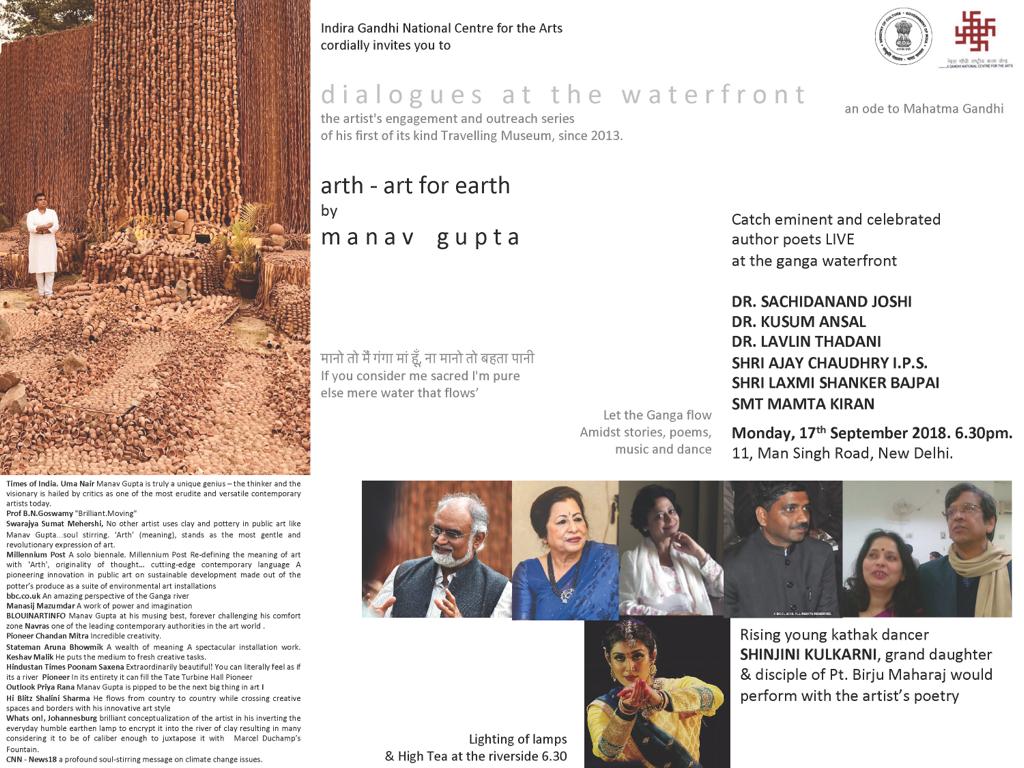
September 14, 2018 | facebook IGNCA Page & Manav Gupta Page arth dialogues at the waterfront.
October 22, 2018 | facebook IGNCA Page & Manav Gupta Page arth dialogues at the waterfront.
by Chitra Balasubramaniam
“Manav Gupta affirms the age-old sanctity of earth and clay, assembling everyday objects made by potters from across India to create huge installations that convey hope, passion, and the journey and transience of life. Using just a few types of functional items—the diya lamp, the kullad tea cup, and the chilam smoking pipe—he succeeds in creating something contemporary yet timeless in its ability to tell a powerful story. Massed in their hundreds and thousands, these humble items gain new significance, as tradition reimagined makes an eloquent case for sustainable practices that respect the earth’s resources while transforming the familiar into something completely unconventional, unexpected, and magical.” – Sculpture Magazine
“I am simply walking the path of infinity with a life dedicated to art. If my humble drop in the ocean can help bring about the change in thinking that is so needed in today’s crass, commercialized, mechanized existence, if it can add a dab of spiritual context to the world as it takes art and culture as a vehicle of change across boundaries, it makes my artistic process that much more fulfilling” – Manav Gupta
‘Arth – art for earth’ is Indian contemporary artist Manav Gupta’s brainchild of 20 years and it explores the meaning of life. ‘Arth’ means ‘wealth’ and ‘meaning’ in the Devanagri script. Through ‘Arth’, a travelling museum which is scheduled to travel across 29 mega cities across the world, the artist explores the earth and nature and urges us to ‘stop a while’ and think about living a life of environmental consciousness. Arth’s exhibitions in clay started in Pretoria, South Africa in 2013 where it was hosted by the National Museum and Indian High Commission. Since then, owing to the exhibition’s success, it has been showcased at various other locations including Aerocity, New Delhi in 2014; India Habitat Centre, New Delhi in 2015; Old Fort, Delhi in 2016; DLF Mall of India, Noida as the Yamuna Project in 2017 followed by a prototype of his Permanent Museum at Amrita Shergill Marg, New Delhi. The 2018 edition was launched on World Environment Day, hosted by IGNCA, Ministry of Culture, Government of India. The artist’s signature suite of ‘excavations in hymns of clay’ is set-up in the 23 acres of IGNCA lawns. The exhibits are made of clay and pottery in different forms imitating nature and are created as ‘excavations’ from ideas of sustainable development. The art installations include ‘The Bed of Life’, ‘The River’, ‘The Beehives Garden’, ‘Rain’, ‘Hourglass – Time Machine, and ‘Noah’s Ark’ and they are made different forms of pottery– earthen lamps (“diyas”), local cigar (“chilam”), earthen cups (“kullar”)– transforming them into monumental art installations which are environment friendly and also supports local artists. What’s more, the travelling museum’s River Waterfront also transforms into a platform for people from different walks of life in the leading megacities to come together and discuss important environmental issues and the need for sustainable development through art poetry and cultural performances. And if we don’t address these problems now, we all will have to be the ‘Noah’s Ark’. The exhibition is currently on-going at IGNCA, New Delhi till October 22, 2018.
Manav Gupta, an eminent artist and founder of ‘Arth: Art for Earth’, talks about taking art beyond art and deploying it to raise conscious environment. One of India’s top ten eminent contemporary artists, he is a visionary and a thinker who has taken art beyond art and has created a movement over his two decades of career by deploying art to raise conscious environment. A Former Expert Committee Member of the Republic Day celebrations and the first artist-in-residence at the Rashtrapati Bhawan, he is the only artist to be invited by Environment Ministry to create films on climate change and has been acknowledged as a pioneer for reinventing pottery as global Public Art for Sustainable Development, taking local to global and craft to Avant grade art. With three global travelling trilogies, his work has been sold by Christie’s, Bonham’s, and in several private and public collections. His biggest solo commissioned artworks include a ten thousand sq. ft. five-floor mega mural at Airtel and the Indo-Bhutan friendship mural in Bhutan. His work has gained recognition in the books of records and amongst the international media. This talk was given at a TEDx event using the TED conference format but independently organized by a local community. Learn more at https://www.ted.com/tedx
By Chahak Mittal
Taking a walk at IGNCA, Chahal Mittal observes and understands that Manav Gupta uses pottery to make a statement on preserving the ecosystem and sustainable development.Artist Manav Gupta has given a new meaning to everyday exotic. He has used earthen lamps, tea cups and smoking pipes, unremarkable in their simple functionality, to create remarkable installations in the gardens of the Indira Gandhi National Centre for the Arts (IGNCA). So while the chillums dangled from branches like rain, the lamps cascaded down concrete steps like a river and the cups honeycombed to form a Noah’s ark. Positing himself at its helm, this is the artist’s powerful message on the art of sustainable living andpreserving Mother Earth before it crumbles and threatens our survival.
Arth: Art for Earth is a concept that the artist has been working on for quite sometime. “For the past two decades, Arth has reigned in my being, my art, my process as the sutradhar. The word arth in Devanagari script refers to ‘meaning’ and ‘wealth.’ I have explored both of them in the context of our existence on this planet as we use the ‘wealth of earth’s resources’ — the five elements (panch maha bhoot) — as well as our meaning and purpose in life while weare here,” says Manav.
Rain, the first of the six artworks by the artist, has chillums tied together with strands of thread on neem and arjuna trees and are used as droplets falling on the lap of the earth. “My ‘rain’ over half an acre of the lawns, is my tribute and nurturing of arjuna and neem trees on this earth,” says Manav.
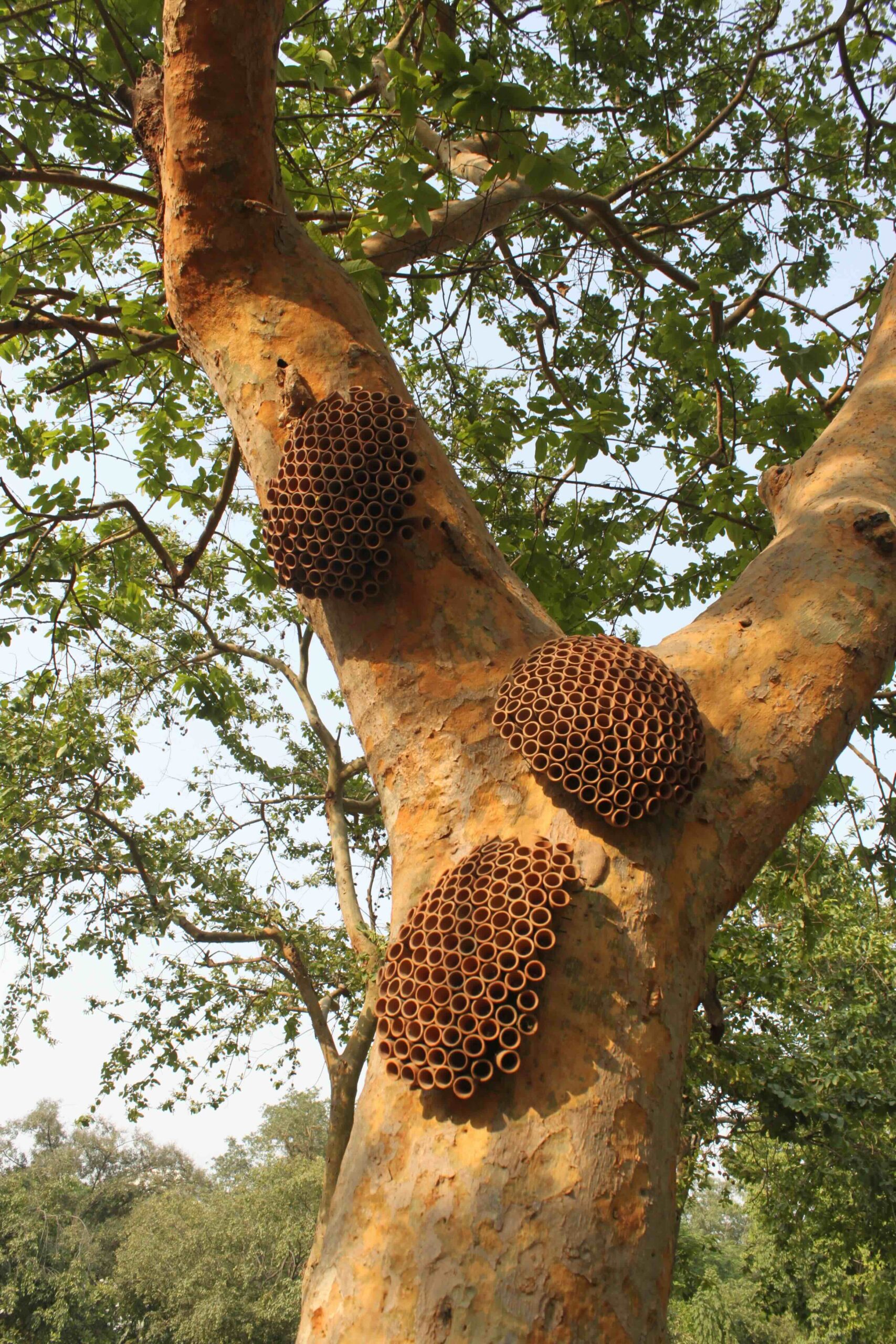
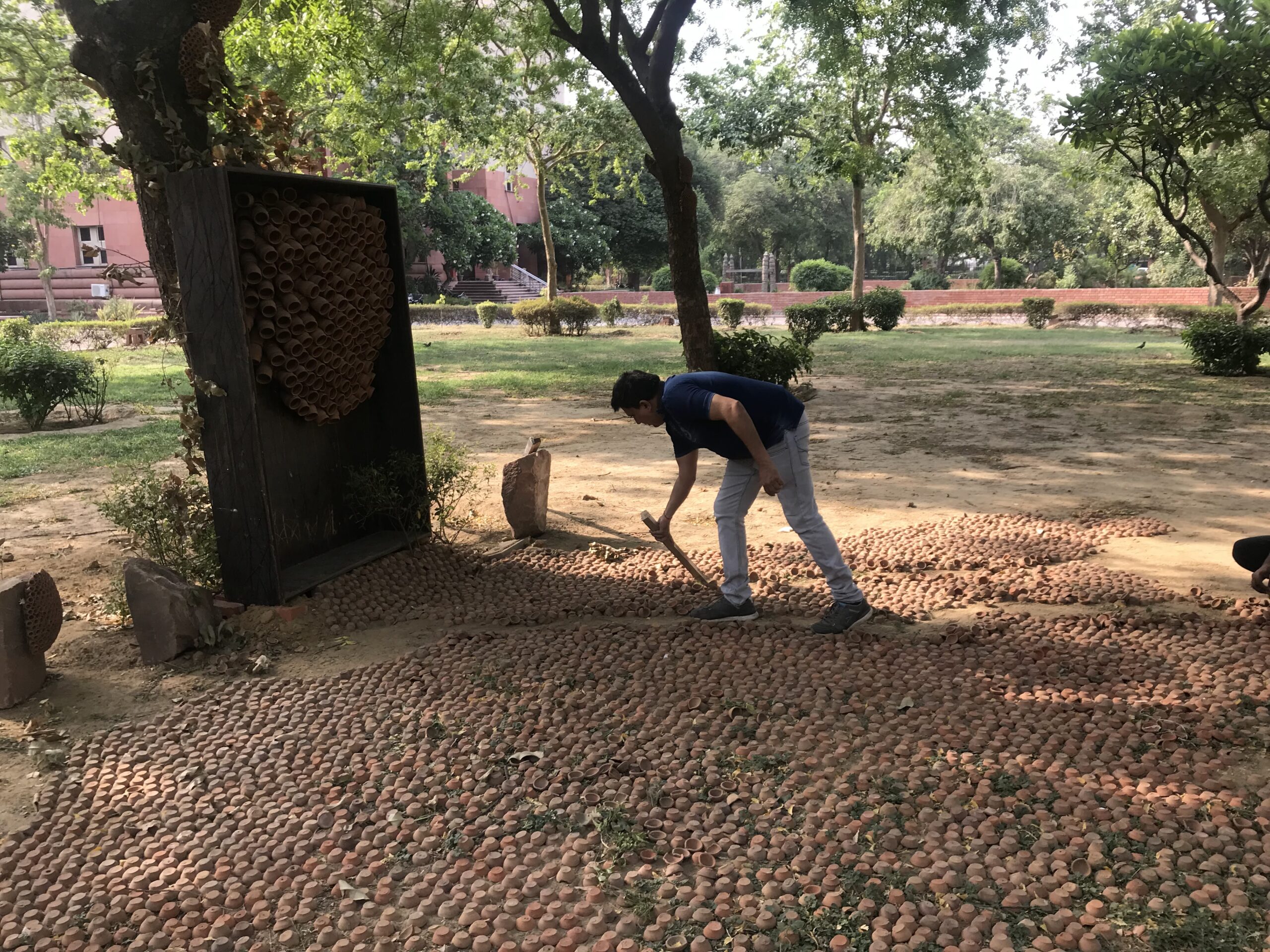
As you walk in the rain, do look at the round beehives perched on the trees, which are made using clay tea cups or kulhars and are huge enough to host a swarm. “I have used clay objects to portray the earth. Diyas are hugely discarded after they are used. The earth seems to have a similar fate, and hence the lamps act as a metaphor.”
As you take a few steps further, we reach the Bed of Life that extravagantly symbolises love, which is “yet another dimension of sustainable development.” The artist shares the intimate statement of love through the use of the masculine and feminine idioms of existence. Despite being fragile, the emotion is ethereal and sublime in its existence, which is why it makes the world go around and upside down.
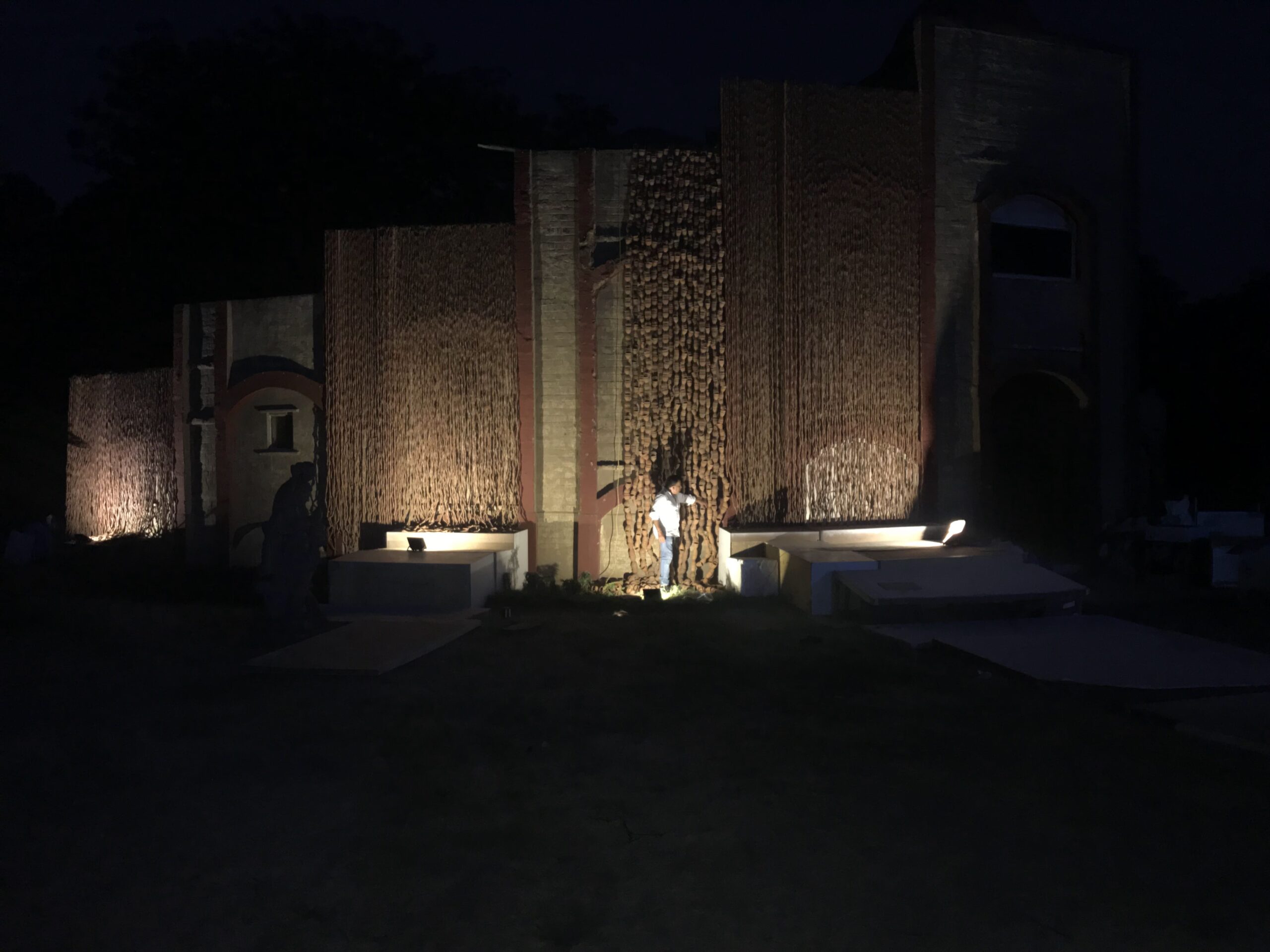
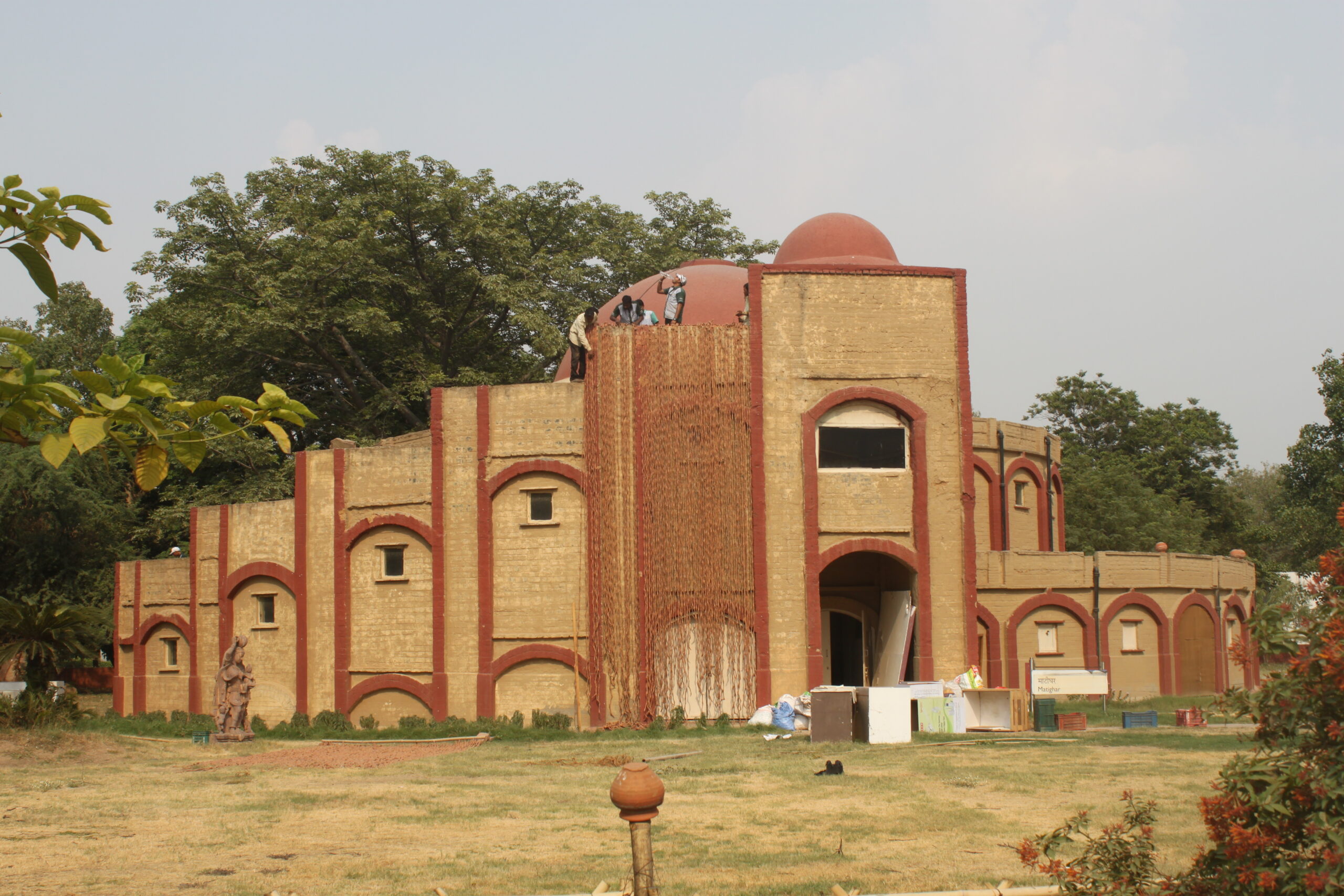
River Waterfront is an ode to Ganga while Matighar portrays the lyrical formlessness of time along the flow of the river. The multi- dimensional sensuousness of strands of the rain dramatically pouring down against a waterfront is a well-executed poetic device.
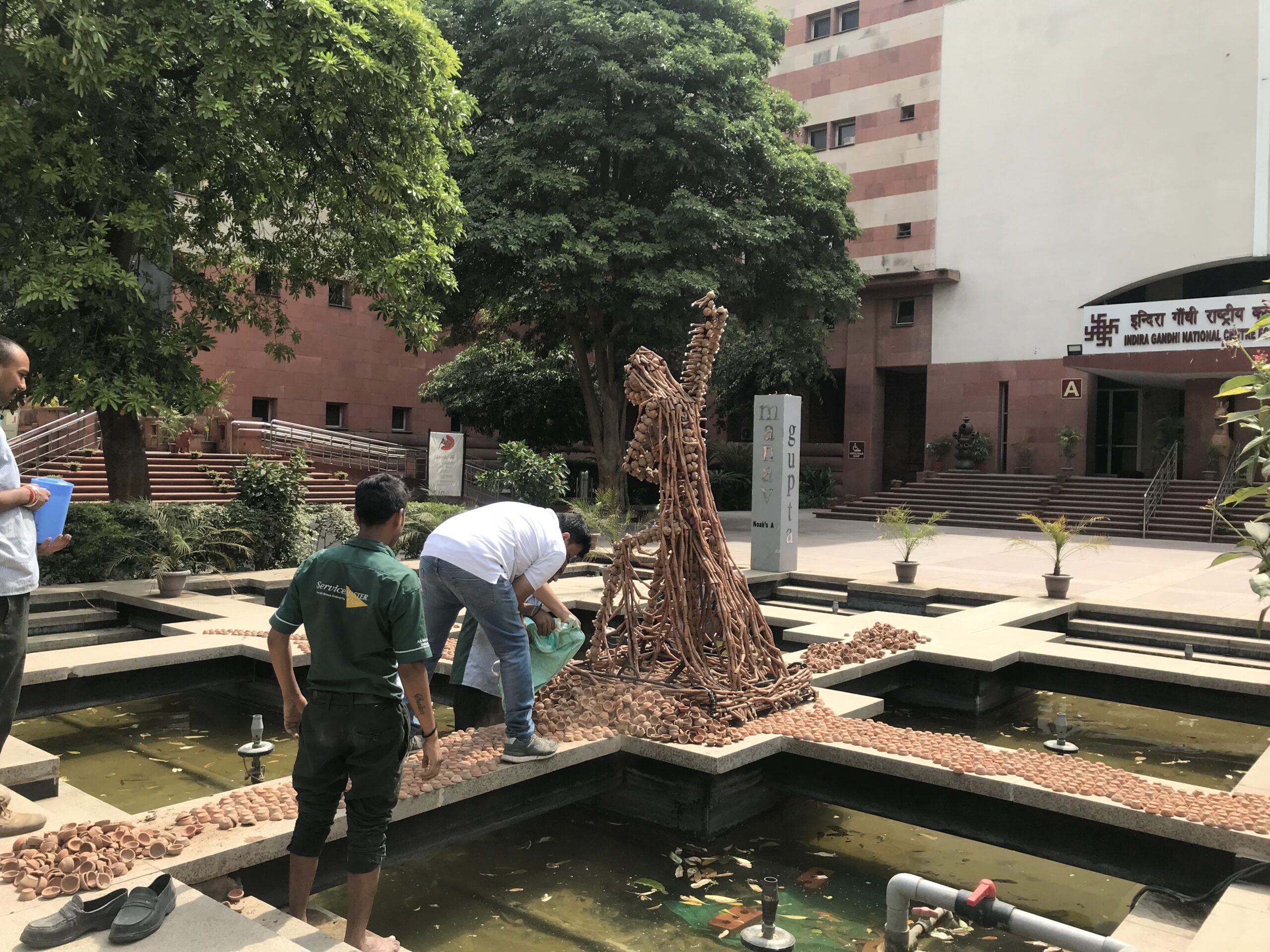
As we walk towards the safe entrance of the IGNCA’s block A, our way is blocked by the prodigious Noah’s Ark made with a thousand chillums and kulhars. “We are all clay and could all be Noahs if we protect ourselves against doomsday by adopting sustainable living. We need to take the future generations of our families and other species to an evolved and secure life,” says Manav.
Predictably enough after the ark, we come to a hardcore message of the Time Machine. The artist uses earthen cups to form an hourglass to highlight the transient nature of our existence. “Water and all the five elements of nature are oursources of sustenance. Ancient civilisations have respected and understood this sanctity. They drew nourishment from the great rivers, be it our sacred Ganga or the Mississippi. As we grow, it’s time we excavate the ancient philosophy of sustainable living. And we are all clay, dust to dust must return. In between, we just get to shape ourselves,” says Manav. At the end of it, we question how our ignorant habits towards the environment can subtly change the very discourse ofnature. And that is the artist’s larger purpose, to set us thinking.
By Sumati Mahrishi
A few years ago, at a display of Delhi-based artist Manav Gupta’s works in Minneapolis, visitors asked him if earthen lamps would survive the snow. Gupta uses clay objects in his body of work, where he embraces nature and architecture. Earthen lamps – his ingredient for the persistent in-depth probe into nature through gigantic installations, were making viewers curious. Gupta’s love for clay, especially the earthen lamp, is deep. So, to quell all doubts regarding life and longevity of clay, he left ‘Shrinking River’, one of the installation works, in Minneapolis snow. Clay, mud, maati – the steel of Indian art history – lies fairly unexplored in public art and other display avenues. Gupta’s work brings it back, from earth to art. He says, “it is a myth that clay cannot stand tough conditions, or that it is perishable. When I left the ‘Shrinking River’ in snow, people were surprised. They understood my belief in clay. They understood clay and its permanence, the fragility of life, our belief in nature and elements as sacred.” He adopted clay as his medium, extensively, in 2013.
No other artist uses clay and pottery in public art like Manav Gupta. His works on nature and climate change are extensive, in harmony with themes and sites he chooses, and soul stirring. In the back drop of the recent Kerala floods, his series, ‘Arth’ (meaning), stands as the most gentle and revolutionary expression of art exposed to rain, trees and sunlight. Depletion of natural resources, recreating and sustaining, are at the core of the series.
At the ongoing exhibition of his works at the grounds of Delhi’s Indira Gandhi National Centre for the Arts (IGNCA), stands ‘Ganga the Riverfront and Matighar’, his tribute to Ganga. The work flows, suspended from the roof top of Matighar the iconic art gallery. It presents a striking depiction of the sacred river in its various flows and stages. “In my view, it is a perfect synergy and tribute to Matighar, which has been closed. The Ganga will lose out if we do not care for it. Concern and activism towards the environment doesn’t have to be noisy. I chose to raise my concern by recreating the river and by engaging with people in mega cities.”
He adds, “my first experience of exhibiting a river depicted in pottery outside India was in South Africa. People there were alien to the idea of diyas and what they are about.”Mimicking nature is an art. Gupta uses clay and deploys seemingly mundane objects of pottery – diya (the earthen lamp), chilum (smoking pipe), khullhad (cup) and ghara (pot) to create rain, waterfronts and rain forests, and other aspects of nature and life. He weaves and assembles the clay objects into installation works in painstaking efforts to mimic nature and to arrive at nature – asclosely as he can.
Why clay? “We are clay. Maati. Dust to dust. Hence, clay. I am clay.” Art is about hope. Offering earthen lamps to people in public art, Gupta hopes that people will not discard diyas, which serve as a “conduit of prayer to the sacred”. Clay is a representative of an element. “It represents earth and human,” he says, “we deplete our resources and we are depleting human kind.”There is more to his choice of material. Metaphors. He is unearthing them through simple objects made of clay. “I am scrubbing the soul,” he says. To him, the first realisation of using clay as a drop came from an inverted diya. “There are artists who can create from cerebral thought. For me, it has to be in the heart, the inside. It (clay) kept growing inside.”Watching Gupta’s ‘Waterfront’ for the second time in Delhi (it was displayed first a few years ago), unravels more depth and details in his work. The presence of clay in several strings of diya, chilum and khullhad woven together to form a river and installed at Matighar, involves a layer of meanings. “It is my tribute to Matighar, which translates into an abode of mud, through my work.”The use of the different shapes and sizes of the numerous diya, chilum and khullhad and gharas used in the “waterfront” gives it a sense of flow. The chilum lends it the cascade, diyas the flow, kullhads – the break in the flow – pace and momentum, and pots – the gurgle, hollows and rocks. Gupta is aware of the ripples of emotions the ‘Waterfront’ creates in the viewer. “Maano to Ganga, Na maano to behta paani (it’s all in the perception – of Ganga as Ganga or Ganga as flowing water),” he says.Gupta relies on architecture and nature to produce installation works out of material, which, if not meticulously blended into his philosophy and thought, would mingle in surroundings – as any other mundane clay object meant for use, as dust. In his art work, these objects become more than mere ‘useful’ kiln-burnt pieces of utility.
They acquire meaning. They become grains of a flow – moments in a story and chapters in Arth, the continuing series of works dedicated to nature and environment. They transform into remnants of an element, beaded together. Assembled together, woven into various patterns with the help of thin wires and knots. “Weaving happens differently. For softer flow, I use chilum,” he adds.In order to connect rivers, people, rain forests and other aspects of nature and life through works of installation that are global in language and Indian in soul, he is required to drop something in particular, regularly. “The pedestal (of high art and perceptions and activism associated with high art).” It is relieving to see his art at a healthy distance from a couple of aspects. First – the elitist approach of looking at nature in language and art work. Second – the piercing cacophony of activism. He believes in simplicity.Time Machine, Beehive Garden, the Noah’s Ark, the Bed of Life are built around metaphors. He wanted to give a message. “The humble clay can serve as luxury.” He adds, “I was surprised to see people at a mall, where my works were displayed, connecting with the works. Similarly, at the most premium addresses in mega cities. People were surprised. They were not sitting at cafes. They were looking at the river. You’ve got to engage the audience right. I believe in people’s intelligence.” He pays attention to viewers’ perception.
At the IGNCA lawns, Gupta’s installations have spent a monsoon – out in the open, under sun, rain, night and day. Clay – maati – his medium for art in Arth develops a warm relationship with the site. “It had to be intrinsic. It had to be Indian. Clay was me.” Gupta describes himself as “non conformist”. He adds, “I have never been in a market-driven exercise (when it comes to works in clay).” He lingers between, around and outside the works, like a protagonist, director and narrator on a unique stage. He is ever present in the continuing drama of a “micro ecosystem” flourishing around his art work and the trees.
Clay talks to the other four elements present at the site in his site specific work in Arth, the series he has pursued over the decades. Its prototypes are housed in his studio in Delhi. The prototypes remain there. The traveling museums (collection of his works) interact with the world and venues. He adds, “Foreign audience is much more impressed, eager and far ahead in terms of wanting the works. As always, it so happens, we (Indians) realise our worth much later.”Rain, his work comprising chilum -the traditional smoking pipe of clay associated with intoxication – strung meticulously into thin wires, succeeds in creating a poetic depiction of rain. The viewer can feel the flow of
drops. The pitter-patter is tapped in a drenching fall in the remarkable use of one element to depict another. Clay for water. Diyas arranged most cleverly on wires define the sense of play in his own understanding of rain and its geometry. “Each strand is important. Each string is important,” he adds.
He catches the flow in broken geometry. He arrives, very close in his work, at the inner texture of the falling rain. It is understood and experienced best when one walks through the strings of clay chilum falling from tree branches. It is while standing between the falling wires studded with the chilum when Gupta’s fine handling of the most simple activity in nature and season, that of rain, arises distinctly. The effect is similar to what a viewer would experience when he sees an object kept between parallel mirrors. This, in particular, is more intoxicating than any intoxication associated with the chilum itself. “I tell my viewers – get drenched in the rain of chilum,” he says.It is fascinating how his work grows and develops for months after he has put up the installations – out in the open. “Trees are my laboratory”, he says. Gupta has used fallen trees for sculptures in the past. In the current display, the falling of rain in Rain from tree branches has a symbolic significance. Rain needs trees, and trees rain.Rain invites life. Worms, insects, birds, creepers, climbers, and seedlings, live and play on and around this installation. Around Bee Hive – another installation. Around the Bed of Life, yet another installation that symbolises the concept of bed as bedrock of love, life, death. Around Ganga – the Waterfront, which symbolises the scared river, and the flowing of time. And then, there is Noah’s Ark, the intriguing piece in the thought chain and cycle.Human presence is pleasant disturbance. Parakeets fly in and out of the Beehive Garden project – one of the most fulfilling works. Parakeets leave feathers behind as temporary mementos on clay on the beehives. The cuckoo continues the dialogue with trees. Other birds visiting the trees discuss their daily lives, swinging on the raindrops of clay in ‘Rain’, once in a while. Crows grumble nesting issues. Ants walk their own little miles on sun dried rain-soaked diyas and moss-curled clay curves.
The clay beehives hung on a tree
The beehives are honey sweet punctuation on trees. They display workmanship, thought, patience, control precision and form. Kulhads – in every work – become the cups of life. He says, “It was very difficult to arrive at the most natural depiction of aspects of nature in general and the beehives in particular. For me, it was important that the form of the beehive remains as natural as possible. The larger beehives just followed. A beehive can turn artificial very easily and quickly. One has to be careful.”Gupta tells Swarajya the reason behind using Arjuna and neem trees for this museum (collection of his works). “Arjuna and neem trees are being lynched for their medicinal values. They have to be nurtured. It is a reverse process. We have to nurture trees and, therefore, rain,” he adds.
The act of weaving, beading, threading knotting, tying untying, assembling dismantling – the fundamental fabric of Indian textures, lives and traditions, is the basis of his unique use of clay. Nature begins to twine around the numerous units of clay in his work. But clay, the medium, itself, remains detached and unnerved by continuing activity around it. It stands in the music of bird song and rain.He has to dismantle “each and every unit” for the travelling museum. The reassembling of the units swirls up a new cycle of recreation every time, every display, every site. Earth to art to metaphor and back. “Dust to dust”. No one uses baked clay for public art like Manav Gupta and nothing scrubs the soul better than clay.
By Pallavi Chattopadyay
The serenity of the riverbed is disturbed by the onslaught of water making its way into it, instantly bringing to the mind the gushing waters of various falls of the country — such as the Chitrakoot waterfalls or the Kempty Falls. But the fall in question is contemporary artist Manav Gupta’s installation, titled River Waterfront.
Indira National Centre for Arts (IGNCA), the mammoth artwork has been created with thousands of the earthen lamps (diyas) made by potters, local cigar (chillum) and earthen cups (kulhar). It pays an ode to the Ganga, glowing with yellow light at night, and symbolising how the river’s path flows from the mountains and pours into plains and distributaries. Five other tall installations come together to form Gupta’s public art project “Arth – Art for Earth”, serving as metaphors for environmental sustainability. Delhi-based Gupta, who was the first artist-in-residence at the Rashtrapati Bhawan after being invited by APJ Abdul Kalam in 2003, brings out the nurturing qualities of the rain through another installation titled Rain. Chillums, recreating the effect of water droplets, hang from strings from the arjuna and neem trees (known for their medicinal properties) and give a drizzling effect to the garden spread across the 23-acre IGNCA premises. “What we do is peel off the barks and wound the trees for medicinal use. But the rains nurture the trees. The idea for this piece lay around why can’t we, as human beings, nurture the trees instead of taking away from them,” says Gupta. Beehives, made using chillums and kulhars around the branches oftrees, turn into storytellers in Bee-hive Garden, bringing attention to the dwindling population of bees. Gupta says, “The UN has declared the World Bee Day (May 20). Bees are a very important part of ecological system because they help in pollination and that’s how vegetables and crops grow. We are always the consumers. Bees are getting extinct and have been declared an endangered species. These beehives made in clay bring in the element of respecting other beings as well, besides nature.”
Then there is the artist’s own interpretation of Noah’s Ark, wherein a male figure appears holding the sail of a ship, made entirely of the three clay objects. “If we don’t take care of nature, we will need to run away from climate change, and row a boat to save ourselves,” he says.
On the use of over a lakh of diyas to create the river effect in River Waterfront and other artworks in his latest exhibition, Gupta says, “We have all grown up seeing the earthen lamp and it has been part of Indian ethos and spirituality. It has a very strange existence. That touched me. It lies on the roadside and is made by potters and we pick it and let it become the conduit of our prayers to god. Suddenly it becomes sacred. The entire perception changes from nothing to everything. In a minute after ceremonies, it is thrown back again after we have used it. That is the metaphor of the earthen lamp.”In that sense, it is not surprising to see clay objects becoming Gupta’s tools lately, including the massive installation of the Ganga waterfront he created in 2016 at India Habitat Centre’s Plaza steps from his series ‘Excavations in Hymns of Clay’. The 50-year-old says, “The human existence and life is because of nature. We are panchmahabhuta — the five elements of earth, water, fire, air and ether. We are all dust to dust, and therefore I use clay. Clay and pottery are my mediums and I use nature as a laboratory.”
Noah’s Ark
Gupta is among the few artists in the country who are using art to raise concerns around the environment. He says, “I try and address environmental problems without noise and the usual protest mode of high decibel shouting. But one can sensitise people. If it touches hearts and souls, art is a very powerful medium. Steve Jobs understood it and used it very well for Apple in terms of the way they present their design. Same can be said about the architecture of a city. My other aim is to engage with the masses, and take art out of the gallery and museum spaces.”
Arth, which translates to “meaning” in Hindi, was picked by the artist as the title of his project “to seek meaning and larger truths of life”. He adds, “Artha also means wealth in Hindi. So what’s the true wealth of humanity. It is actuallynature and the natural resources. That is what makes us survive. It is not the money or commercialisation.”
The exhibition is on at IGNCA, CV Mess, Janpath, till October 22
By Simantini Dey
Manav Gupta, a Delhi-based artist, has been using different art forms to talk about environmental issues for more than two decades now. The artist’s claim to fame may have been a five floor high mega mural that has set a world record, but, what makes Gupta’s work unique is his capacity to amalgamate poetry, art, music and several other forms to deliver a profound soul-stirring message on climate change issues. Gupta’s climate change arts aren’t a form of activism for him, but an in-depth inquiry, a thorough investigation of nature. “Nature’s process of creation, as it exists in its timelessness, in its oneness and peace, has all the answers to man’s need of growth, progress and development,” said the artist.If human endeavors first absorb and then adopt these answers in its developmental process, the growth from cities to mega cities and path to progress would not create silent self-digging graves of human extinction,” he added.Gupta, however, is well aware that the ‘silent self-digging graves of human extinction’ he mentions seldom draws public attention, which is why, he is determined to take the movement on climate change to the general public through simple yet unique art that is displayed in public space.The world needs more public art that can influence people, said the artist. Gupta believes that there is a need to think from the heart, rise up and have an overview, take a higher stand. “It’s not an elitist, intellectual, superior pedestal with a language that half the world doesn’t understand. It’s in the delivery of simplicity with elegance that one can create a consciousness,” said Gupta. Gupta’s climate change arts aren’t a form of activism for him, but an in-depth inquiry, a thorough investigation of nature. “Nature’s process of creation, as it exists in its timelessness, in its oneness and peace, has all the answers to man’s need of growth, progress and development,” said the artist.”If human endeavors first absorb and then adopt these answers in its developmental process, the growth from cities to mega cities and path to progress would not create silent self-digging graves of human extinction,” he added.Gupta, however, is well aware that the ‘silent self-digging graves of human extinction’ he mentions seldom draws public attention, which is why, he is determined to take the movement on climate change to the general public through simple yet unique art that is displayed in public space.
The world needs more public art that can influence people, said the artist. Gupta believes that there is a need to think from the heart, rise up and have an overview, take a higher stand. “It’s not an elitist, intellectual, superior pedestal with a language that half the world doesn’t understand. It’s in the delivery of simplicity with elegance that one can create a consciousness,” said Gupta. Because I have always strongly believed that we can never underestimate the intelligence of masses. As an artist I dwell on their intelligence. That’s where possibilities of big change exists,” he added.
So far, Gupta has shown great persistence in trying to involve the public in the discourse on climate change through his work. In little more than 20 years, Gupta has built up a vast catalog of art projects on environment. Gupta started in 1997, when climate change was hardly a topic artists chose to work on.Gupta’s public arts on climate change is extensive. In 2003, as a genesis of his Public Art Projects, Gupta started ‘Plant a sapling on my canvas’ project where he invited people from all walks of life to collaborate with him on the canvas.In 2009, his project Beyond Politics, Beyond Copenhagen, For Our Children consisted of a treatise, a travelling trilogy of art, as well as lectures and films on Sustainable development.However, in 2013 his most significant work on climate change, ‘Excavations in Hymns of Clay’ began. “In 2013 extending my practice in painting, I adopted clay as an extensive medium for my installations for Museums, private space and most importantly gigantic versions at public spaces towards raising environment consciousness,” said the artist.Gupta’s public arts on climate change is extensive. In 2003, as a genesis of his Public Art Projects, Gupta started ‘Plant a sapling on my canvas’ project where he invited people from all walks of life to collaborate with him on the canvas.Gupta’s public arts on climate change is extensive. In 2003, as a genesis of his Public Art Projects, Gupta started ‘Plant a sapling on my canvas’ project where he invited people from all walks of life to collaborate with him on the canvas.”I chose clay because we are all clay. Dust to dust,” he added.“I inverted a Diya (earthen lamp) used it as a metaphor of a drop of water. The power of the message that it generated was heartwarming. People came and sat beside my river in South Africa within the walls of the National Museum and with their hands on chin, sat for hours absorbing the message while they soaked in the tranquility of the medium,” said the artist.
Gupta had also done the ‘River Waterfront’ project where he deployed pottery to connect rivers, waters and the people of the world. Another significant project by Gupta in which he used earthen lamps is the Yamuna Project that was displayed at a big mall (DLF mall) in Delhi. Gupta interspersed different installations like the Waterfront, the Beehives Garden, the Noah’s Ark, the Time Machine and the Bed of Love as site specific engagements of sustainable solutions amidst stores that sold premium global brands.Whether it is the Time Machine, Bee-hive Garden, River Bed of Love, or the Noah’s Ark, the artist, through all these installations wanted to convey the fragility of clay juxtaposed with the limitedness of life. Gupta used these installations as metaphors to outline the rapidly mechanized and constructed consumerist world and its interaction with earth’s resources.”“I make it simple – ‘Keep it simple’ is my mantra… Simple CAN be intriguing and have mystique,” said Gupta. The artist said he finds greatest satisfaction when everyone can relate to his art. That is his driving force.“My art contains enquiry within it, probing hitherto untouched elements of thought,” he said. Activism or concern for climate change need not be all noise or loud or ugly. Quiet can be as penetrating if not more.At a time when world leaders are still denying climate change, it is not only important for scientists to remind people of the magnitude of threat that looms on entire humanity but also for writers, painters, dancing and musicians to help people understand this threat, and provoke them to take actions. They are painting the picture that hits hard.
#ClimateArt is our series to discover how art, music and literature have the potential of changing opinions and beliefs about climate change.
Press Information Bureau Government of India Ministry Culture
05-July-2018 21:06 IST
Minister of State for Culture(I/c) Dr. Mahesh Shrama Inaugurates exhibition titled “Arth – art for earth” at IGNCA, New Delhi, today.
Union Minister of State for Culture(I/c), Dr. Mahesh Shrama, inaugurated exhibition titled “Arth – art for earth” at IGNCA, New Delhi today.‘ARTH – ART FOR EARTH’ by Manav Gupta consists of “Excavations in Hymns of Clay” – a suite of environmental art installations by Manav Gupta weaving all of them with a storyline and poetry. It is an evolving site, specific and dynamic engagement with the space it has an interface with – whether it be the Travelling or the Permanent editions. Speaking at the event, the Minister said that Culture is our Strength and Identity, and the artists are the people adding strength to this identity. Appreciating the Exhibit he also complimented IGNCA for the efforts. Dr Sachcidanand Joshi, Member Secretary, IGNCA, Shri Ram Bahadur Rai, President, IGNCA, Shri Amitabh Kant, CEO, Niti Ayog and many other dignitaries were present at the event.
As a public art project, the artist deploys the quintessentially Indian potter’s produce of clay objects such as the earthen lamps (“diyas”), local cigar (“chilam”), earthen cups (“kullar”) to transform their individual identity into metaphors and idioms of sustainability, context, perception and treatment as he conceptualizes and creates large scale avant-garde works; using the rural Indian pottery meant for everyday use, in mass numbers, he deconstructs their age old existence as units to make them lend themselves to another form, be it in a Duchamp like inverted concept or simply rendering them formless. They stun the viewer with the artist’s originality of thought as he produces a cutting edge contemporary language whose global vocabulary is derived from the “local”. In his “excavations” of the spiritual philosophy of sustainable living as espoused in Indian scriptures, he executes an organic engagement of art with architecture and space to explore it in its universal context. While one is lured intelligently within the sensuousness of the ‘Waterfront’, ‘River of clay’, or ‘Rain’ letting one feel the ethereal, emotive content like that of an epic story, Manav’s statement is dipped gently into the essence of the Indian vedic practices to subtly bring to light the repository of solutions that the ancient way of life could offer in today’s context of sustainable development and current issues around rivers like the Ganga. Whether it be the latest “R a i n ” or the “River waterfront” ‘Time Machine’, ‘Bee-hive Garden ’, ‘River Bed of Love’, or the ‘Noah’s Ark’ the fragility of clay juxtaposed with the limitedness of the “cup of life” question the paradigm of Time and human engagement with it in today’s rapidly mechanized and constructed consumerist engagement with earth’s resources. The works, conceptualized, created and constructed taking into consideration the venue – is a sensitive natural interface with the ambience, seeking to engage fresh and locally relevant dialogues and questions that audiences can have with the art and within themselves.
The exhibition is available for public viewing till the 22nd of October 2018.
By Swati Rai
Manav Gupta’s Arth — Art for Earth carries forward his commitment of two decades towards innovation and sustainability. In the installation, he deploys Indian clay objects like diyas, chilam and kulhar and transforms their individual identity into metaphors and idioms of sustainability.
Six installations — Rain, The River Waterfront, Time Machine, Bee-hive Garden, The Bed of Life, and Noah’s Ark — form part of this public art display at the Indira Gandhi National Centre for the Arts (IGNCA). Through them, the artist seeks to portray traditional Indian pottery as a metaphor for nurturing the environment in a consumerist society. “In Devanagari, arth stands for ‘meaning’ and ‘wealth’. I have explored both these concepts in the context of our existence on this planet as we use a wealth of earth’s resources, the five elements (panch maha bhoot), as well as our meaning and purpose in life while we are here. We all are clay. Dust to dust. My art seeks to submit to this paradigm.
”The River Waterfront — An Ode to Ganga seeks to create awareness about the conservation of rivers and their organic essence to our lives. In The Time Machine, the artist engages with time and its transient passage. In Noah’s Ark, Gupta uses symbolism to underline the relevance of saving the world.
The Beehive Garden Project is a statement on biodiversity and its crucial linkages to sustainable development. The Bed of Life highlights the fact that love is what makes the world go around. The river bed of earthen lamps and earthen cups is symbolic of history, of love, of beginning and the end. Just like the circle of life.He says his focus is on making meaningful art for the masses. He says people might interpret the works in their own way, buthis purpose is to be able to engage in a dialogue around sustainable development through innovative art forms.
New Delhi, July 5 (IANS) Union Minister of State for Culture Mahesh Sharma here on Thursday inaugurated a public art exhibition titled “Arth: Art for Earth”, curated by artist Manav Gupta.
Speaking at the event at the Indira Gandhi National Centre for the Arts, the Minister said that the “Indian culture is our strength and identity, and artists are people adding strength to this identity”.
With an aim to promote environmental consciousness, Gupta has created six environmental installations, using thousands of earthen lamps (diyas), cigars comes (chillams) and cups (kulhars) as primary material. The material, Gupta says, from the nature and also symbolises it. The works transform the individual identity of these earthen vessels into metaphors and idioms of sustainability, context, perception and treatment. “A diya (an earthen lamp) is discarded after use. I’ve used it as a metaphor for mother earth, which seems to have a similar fate,” the artist said at the inauguration.
He, through these works, has converted “rural Indian clay pottery into avante garde contemporary installations that embrace nature”.
The installations are: “Rain”, “Ganga the Riverfront and Matighar”, “Time Machine”, “The Beehive Garden” , “Bed of Life”, and “Noah’s Ark”.
Through the massive installation on river Ganga’s waterfront, Gupta aims to highlight the solutions “an ancient way of life could offer in today’s context of sustainable development and current issues around rivers”.
The intricate installation symbolises the mountains, from where the Ganga takes birth and then flows down into the plain and forks into distributaries.
Speaking about his installation about rains, he said: “It has been installed on Neem and Arjun trees, barks of which are extracted for medicinal purposes. To (metaphorically) nurture those plants, I’ve created an installation called rain.”
With these works, Gupta hopes to spur dialogues and questions that audiences can have with the art and within themselves. The exhibition is open for public viewing till October 22.
Re-defining the meaning of art with ‘Arth’ Team MP5 July 2018 9:28 PM Indira Gandhi National Centre for the Arts raised the curtain for ARTH – Art for the earth on July 5 at the IGNCA, CV Mess, Janpath, New Delhi. The chief guest for the inauguration ceremony was the State Minister of culture, environment, forest and climate change, Dr Mahesh Sharma. The exhibition which is up for display until October 22 – is the first its kind public art project on the environment by one of India’s leading contemporary artists – Manav Gupta.
Comprising of “Excavations in Hymns of Clay”– a suite of environmental art installations by the artist, weaving all of them with a story-line and poetry. ‘Arth’ is an evolving, site-specific and dynamic engagement. As a public art project, the artist has tried to deploy the quintessentially Indian potter’s produce of clay objects such as the earthen lamps (diyas), local cigar (chilam), earthen cups (kullar), with the idea to transform their individual identity into metaphors and idioms of sustainability, context, perception and treatment. The clay objects and other items displayed in the exhibition will stun the viewer with the artist’s originality of thought as he produces a cutting-edge contemporary language whose global vocabulary is derived from the “local”. Emotive content like that of an epic story, Manav’s statement is dipped gently into the essence of the Indian Vedic practices to subtly bring to light the repository of solutions that the ancient way of life could offer in today’s context of sustainable development and current issues around rivers like the Ganga.
Whether it be the latest ‘Rain’ or the ‘River waterfront’ ‘Time Machine’, ‘Bee-hive Garden ‘, ‘River Bed of Love’, or the ‘Noah’s Ark’, the fragility of clay juxtaposed with the limitlessness of the “cup of life” question the paradigm of time and human engagement with it in today’s rapidly mechanized and constructed consumerist engagement with earth’s resources. The works, conceptualised, created and constructed by the artist while taking into consideration the venue – is a sensitive natural interface with the ambience, seeking to engage fresh and locally relevant dialogues and questions that audiences can have with the art and within themselves
Arth-
Art for Earth-
The Excavated Museum of Clay
by
Manav Gupta
Date: 05/07/2018 – 25/11/2018
Time: 9:00 am – 9:00 pm
Venue: Lawns, 11, Mansingh Road, IGNCA, New Delhi
IGNCA cordially invites you to the first of its kind public art project on environment by one of India’s leading contemporary artists.
The art exhibits explore nature as a museum laboratory of art, espousing sustainable development by excavating the philosophies of ancient civilizations, like Indian vedic practices, on environment. The artist converts quintessential rural Indian clay pottery into avant garde contemporary installations that embrace nature through the five elements.
Join us to experience
– Rain
– Ganga the Riverfront and Matighar
– Hourglass – Time Machine
– Noah’s Ark
– The Beehive Garden
– Bed of Life