A private garden becomes the most radical museum of its generation — and the most quietly urgent argument for what we are about to lose.
Period
2017 – 2018
Location
Amrita Shergill Marg, New Delhi
Form
Prototype Museum
Installations
6 Major Works
Medium
Terracotta · Clay · Earth
I
InTRODUCTION
The most consequential art does not announce itself. It waits. It inhabits a space — a garden, a staircase, a tree — and asks you, with the patience of something very old, to stop moving and look at what has always been in front of you. Manav Gupta’s Sculpture Garden, installed across half an acre of a private residence on Amrita Shergill Marg between 2017 and 2018, is this kind of art. It does not perform. It reveals.
And what it reveals — about material, about attention, about the grotesque confusion at the heart of how we assign worth to things — is a proposition so straightforward and so radical that the art world, still caught in its own machinery of scarcity and prestige, has not fully reckoned with it.
Prosaic can be luxury. Five words. The compressed statement of a philosophy thirty years in the making.
To understand what Gupta was doing in that garden, you have to understand what he was refusing. The late 2010s were a moment when Indian contemporary art was deepening its courtship with international validation — biennales, art fairs, the auction record as biography. The question being asked, politely and otherwise, was: how does Indian art insert itself into a system whose centres of gravity lie elsewhere?
Gupta’s answer was to refuse the question entirely. He took half an acre of cultivated land in one of Delhi’s most storied neighbourhoods, planted six monumental works in it, and invited ambassadors, ministers, potters, and schoolchildren to stand in it together. He called the whole thing a prototype museum. The prototype was the argument. A museum that requires no institution. A garden, an artist, clay, trees, and the willingness to begin.
The Six Works · 2017–2018
Six installations. Half an acre. One argument.
Environmental Installation · Global Premiere
Rain
30 ft × 100 ft × 20 ft
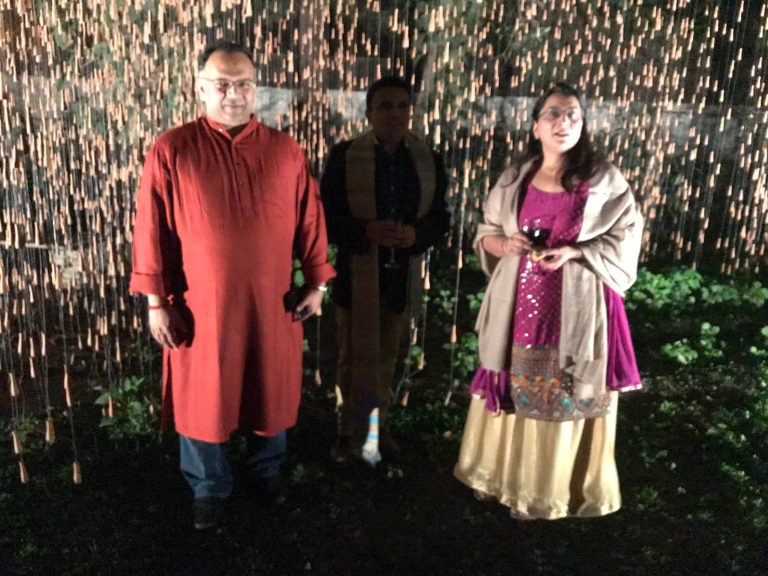
Thousands of terracotta chillums suspended from above — a monsoon arrested mid-fall. To stand beneath Rain is not to look at it. You stand inside the rain. And in that standing you understand, bodily rather than intellectually, that these objects purchased from poverty-line craftsmen contain something no amount of money can manufacture: the accumulated intelligence of a civilisation’s relationship with water, fire, earth, and time. The most prosaic of objects, multiplied into the monumental, reveals itself as luxury of the highest order: pure presence.
Land Installation · The Ganga
River
20 ft × 20 ft × 40 ft
The Ganga’s curve traced through a private South Delhi garden in earthen form — not the postcard river of tourism, but the river as civilisational conscience. To walk alongside this work is to feel, in your body, the weight of what disappears when a river disappears. The sacred intrudes into the domestic. The horizontal immensity of a river — plain-crossing, city-nourishing, delta-feeding — is returned to a city that has turned its back on the water that made it possible.
Ecological Installation · Living System
The Beehive Garden Project
Single unit · Vertical span · Half an Acre
Operating at three scales simultaneously — the cell, the hive, half an acre of living garden — this is the only work that becomes continuous with the ecology it evokes. Parakeets came and nested in the clay hives. They did not know they were visiting an installation. They knew they were visiting a hive. That is the measure of what was made: the natural world recognised it as kin.
Sculpture · Climate Reckoning
Noah's Ark
8 ft × 10 ft × 10 ft
Built from clay — the same material that rising waters will claim. It carries no animals. It holds only the question: what have we already decided we can afford to lose? It sits on dry land not as a vessel of salvation but as a monument to our recklessness — and a mirror held up to every generation that sees it.
Kinetic Sculpture · Hourglass
Hourglass - Time Machine
7 ft × 5 ft × 5 ft
Hundreds of kullads — the disposable tea cups of every Indian railway platform — assembled into a seven-foot hourglass. The form confronts two irreconcilable relationships with time: the industrial, which seeks to defeat it, and the vernacular, which has always known the cup will be crushed and has never stopped making cups. The hourglass does not moralise. It makes the confrontation inhabitable.
Sculpture · The Domestic Sacred
The Bed of Life
4 ft × 7 ft × 10 ft
We are born in a bed, we love in a bed, we die in a bed. No object holds more of our biography, and none is more thoroughly stripped of significance by its ubiquity. Rendered in clay and fire, the domestic object recovers the ceremonial gravity it never actually relinquished — only habituated away from. This is the prosaic returned to the sacred from which it was never truly separated.
The Material Argument
Gupta does not transform these objects. He restores our capacity to see what was always there.
Before one can speak about what these sculptures mean, one must speak about what they are made of. This is not a preliminary matter. In Gupta’s practice, material is meaning — not a vehicle for it, not a support for it, but its primary and irreducible form.
The medium throughout is, in its various manifestations, earth: terracotta, river clay, the fired diyas of the kumhar’s wheel. These are not materials chosen for novelty, technological sophistication, or theoretical valence. They are among the oldest materials in human use on the subcontinent, deployed here at a scale and ambition that refuses to let their familiarity function as diminishment.
The kumhar — the traditional potter of northern India — has been throwing vessels on the wheel for thousands of years. The diya costs next to nothing. It is sold in bulk at street markets. It is, by every measure the luxury economy applies, worthless. Gupta’s fundamental intervention is to treat this invisibility not as a fact about the object but as a failure in the beholder. The diya is not humble. The clay vessel is not poor. Our inability to see their richness is a poverty of attention — a cultural myopia induced by a market that has confused scarcity with value and brand with meaning.
Taking Art Beyond Art
Activities, processes & thought experiments that made the garden a movement.
◈
Process
Creating an Art Lab
The Sculpture Garden was not merely exhibited — it was built live, in the presence of the earth and the seasons. An art laboratory where the process of making was itself the first work. The studio became the public. Failure and revision were exhibited alongside completion. In doing so, Gupta dissolved the most stubborn fiction in art: that the work begins when the making ends.
✦
Ceremony
Lighting of Earthen Lamps
At the Ganga waterfront, Gupta led the lighting of earthen lamps — each one hand-formed from river clay — as a ceremony of environmental consciousness. The diya, the most prosaic of objects, became a diplomatic gesture: dozens of nations brought to the same river, the same light, the same silence. No protocol officers. No communiqués. The lamp was placed. The river received it.
∿
Discourse
Dialogues at the Waterfront
The river became a seminar room. Gupta convened conversations between ambassadors, policy architects, environmental scientists, and artists at the waterfront — not in conference centres but in the living presence of the Ganga. Ideas form differently beside moving water. Connections made in the presence of the river carried a different weight than those made across a conference table.
◯
Practice
Meditations
Structured silences within the installations — meditations guided by the work itself rather than instruction. Visitors were invited to remain with a single sculpture for thirty minutes without commentary. In an age of the instant, this act of sustained attention was itself a radical practice. Several ambassadors returned for second, then third meditations. The garden became a place of genuine inner work.
⊕
Outreach
Education Outreach
Children from Delhi schools were brought into the garden not as audience but as participants — throwing clay, placing diyas, walking the river installation. Art education here was not instruction in art history but induction into a way of attending to the world. The curriculum was the garden. The teacher was the clay. The lesson was irreversible: once you have made something from the earth, you cannot be entirely indifferent to the earth again.
◎
Diplomacy
Connecting Nations
Representatives from over twenty nations engaged with the garden through formal discourses, informal walkabouts, and the shared ritual of the Ganga lamp-lighting. Art served here as a form of diplomacy that bypasses the apparatus of diplomacy — no prepared statements, only genuine encounter mediated by clay and fire. These connections crossed borders that political protocol cannot easily cross.
△
Philosophy
Power of Thought Experiments
Each sculpture was prefaced by a structured question posed to the visitor before they approached the work. What if the monsoon stopped? What would you carry onto an ark? What lives in the earth beneath this city? The sculptures were not answers. They were the best possible form a question can take. Thought experiments that did what only art can do — make abstraction physically inhabitable.
◊
Influence
Discourses with Stakeholders
Niti Aayog’s CEO, India’s Ministers of Culture, UN Resident Coordinators, Consuls General — the garden drew those whose decisions shape the material world and invited them into a space governed by an entirely different set of values: slowness, materiality, ecological humility. Whether or not they left changed is less important than that they stayed, and looked, and found themselves without adequate language for what they felt.
※
Vision
Prototype Museum
Gupta’s designation of the Sculpture Garden as a prototype museum is not marketing — it is a genuine hypothesis about institutional form. A museum that requires no institution. No acquisitions committee. No conservation department. No board of trustees. A garden, an artist, and the willingness to begin. The prototype proved the concept: that the functions of the museum can be achieved without the museum’s infrastructure, if the art is willing to carry the full weight of the encounter.
The Movement
Prosaic Can Be Luxury
The most important word in the proposition is not luxury. It is can. It is the word that refuses prescription — that insists on possibility rather than hierarchy. It does not say: the prosaic is luxury, flattening all distinction. It says the prosaic contains the capacity for luxury, if we are willing to attend to it. The artist’s role is to create the conditions of that attending.
Luxury, properly understood, is a quality of presence — the experience of a thing fully attended to, fully understood, fully in contact with the intelligence that made it. And by this measure, the terracotta diya sold for next to nothing is already one of the most luxurious objects on earth. It carries the fingerprints of its maker. It holds light. It carries the petition of the person who lit it. It is, in its modest and crushable body, a concentrated archive of civilisation.
What Gupta’s Sculpture Garden did was restore access to this archive. Not by explaining it. By making it impossible to ignore. By filling a garden with ten thousand acts of human making and asking the viewer, quietly, to reconsider what they had been calling valuable.
This is not a retreat from the contemporary. It is its most urgent intervention. In a cultural moment defined by the artificial scarcity of the art market, the brand logic of luxury goods, and the relentless monetisation of attention itself, the act of insisting that the overlooked is already sufficient — that nothing need be added, only seen — is among the most radical gestures available to art.
The artist’s function is not transformation. It is restoration — restoring to the viewer a quality of seeing that daily life has systematically taken away.
Gupta has spent thirty years building toward this proposition, beginning with his Arth — Art for Earth movement in 1997, through the decade of mural-making that culminated in a world record, through the sustained excavation of clay as civilisational medium that the series Excavations in Hymns of Clay represents. The Sculpture Garden is the fullest inhabitable expression of the argument — the place where the philosophy becomes something you can walk through, stand inside, and carry home in your body.
This is the game-changing claim. Not that the artist has alchemised clay into culture. The clay was always culture. The game-changing move is the refusal of the false hierarchy — the insistence that the potter’s hand and the collector’s eye are engaged in the same civilisational project, and that the work of the former requires no intermediary to be complete.
01
The Material
Terracotta, river clay, earthen lamps. The most ancient palette of the subcontinent, deployed at monumental scale without apology and without institutional endorsement.
02
The Method
Artist-led, artist-executed. The human hand visible in every vessel, every seam, every imperfection. No industrial fabrication. The maker present in the made.
03
The Claim
Attentiveness is the only luxury that cannot be purchased. The prosaic, attended to with rigour, contains everything the rare pretends to offer — and has always contained it.
04
The Legacy
A prototype museum model requiring no institution, no white cube, no market validation. Only a garden, an artist, and the courage to propose that what we already have is already enough.
Climate Consciousness
Art as ecological conscience — before the world caught up.
In 2017, when the Sculpture Garden was conceived, the global art conversation had not yet arrived at the ecological urgency that now defines it. Gupta had been there since 1997. His entire practice — from the first commissioned films for India’s Ministry of Environment, to the River installation that laid the Ganga’s shrinking curve on museum floors across continents, to the Beehive Garden Project that preceded the UN’s declaration of World Bee Day — is structured around a single ecological proposition: that the crisis of the natural world is also a crisis of attention.
We do not destroy what we genuinely see. The Sculpture Garden was not a protest. It was something more ambitious: a sustained attempt to restore in its visitors the quality of seeing that makes destruction impossible. Each installation is, simultaneously, an artwork and an ecological argument — not illustrated but inhabited, not explained but felt.
The Climate Emergency has since confirmed everything Gupta was proposing in clay. The Ganga continues to shrink. The bee populations continue to decline. The monsoon patterns continue to shift. The ark continues to sit on dry land. The only thing the Sculpture Garden could not predict is how little time remained for the argument to be heard before the evidence arrived to make it for us.
Water Crisis
Rain & River
The monsoon suspended in clay; the Ganga’s curve laid in earth. Together they make a single argument: water is not infrastructure. It is the condition of life. Its absence is not an inconvenience. It is the end of a civilisation. These works preceded the most acute phase of India’s water crisis and named it before the data arrived.
Biodiversity Collapse
The Beehive Garden Project
Created in 2013, four years before the UN declared World Bee Day. Built from kulhads and chillums — objects of maximum disposability — assembled into the architecture of maximum ecological intelligence. A civilisation that cannot value the disposable cup cannot value the hive. The metaphors are the same metaphor.
Rising Waters
Noah’s Ark
Built from clay that rising waters will claim. Every civilisation has its flood myth; every flood myth is a climate document. The ark asks not for salvation but for reckoning. It grows more urgent with each IPCC report. It was always urgent. We were simply not yet willing to see it.
Civilisational Time
Hourglass – Time Machine
The sands in the hourglass are the same alluvial deposits that built the cities of the Indus Valley. To engage with this object is to handle civilisational time and understand, bodily, that the human relationship with the earth operates across timescales our economic models cannot accommodate. The sand runs. The cup will be crushed. The choice is what we do while there is still time to choose.
Voices from the Garden
What happened when the world stood still in a garden made of earth.
Vision and passion beyond imagination — bringing nature and the creation of the common man to an exclusive presentation. This needs to reach every corner of the world.
Dr Mahesh Sharma
Minister, Ministry of Culture, Government of India
What a privilege to see the installations — which have the effect of stirring the imagination while leaving you feel so peaceful.
Sir Dominic Asquith
British High Commissioner to India
We have just fallen in love with the clay rain. It is peaceful and meaningful. It holds the tradition of India and at the same time is full of creativity. A modern piece of art in the land of heritage so rich.
José Ramón Barañano Fernández
Spanish Ambassador to India
Your creativity and talent is inspiring — we are truly impressed by your vision and expansive depth of presence. We look forward to exploring collaboration with Canada.
Nader Patel
Canadian Ambassador to India
What a spectacular monsoon of talent — congratulations for an intoxicating display.
Max Rodenbeck
South Asia Bureau Chief, The Economist
Spiritually invigorating, culturally rejuvenating and mentally elevating. A brilliant exhibition by our outstanding artist of immense creativity — it brings alive India’s civilisation.
Amitabh Kant
CEO, Niti Aayog, Government of India
Breathtaking — overwhelmed by bliss. Water. Forests. Rain. Spirit. Beautiful, beautiful work of art and highly evocative.
Mariela Cruz Alvarez
Costa Rican Ambassador to India
Amazing art, in an amazing place by an amazing artist.
Savina Amassari
United Nations Resident Coordinator
The concept, the creativity, the philosophy — everything provokes us to think and realise what we are and what we should be.
Mr & Mrs Rajeeva Shah
Former Planning Commission Secretary, Govt of India
Mr Amitabh Kant
CEO, Niti Ayog, Govt of India
“Excavations in Hymns of Clay is spiritually invigorating, culturally rejuvenating & mentally elevating. Its a brilliant exhibition by our outstanding artist of immense creativity! The exhibition brings alive India’s civilization. My congratulations to Manav. Its been a wonderful experience viewing the exhibition.”
Dr Mahesh Sharma
Minister, I/C, Ministry of Culture, Govt of India
Vision and passion of Manav ji is beyond imagination. Bringing Nature and creation of a common man ‘ Kumhaar’ who shapes the sand to Diya is chillam to an exclusive presentation with the theme and with this a New Concept. Need to showcase this talent to every corner of World.
Mr Max Rodenbeck
South Asia Bureau Chief, The Economist
What a spectacular monsoon of talent! Manav congratulations for an intoxicating display.
Sir Dominic Anthony Gerard Asquith
British Ambassador to India
What a privilege to see the installations- which have the effect of stirring the imagination for leaving you feel so peaceful.
Mr Nader Patel
Canadian Ambassador to India
Manav, Thank you for such a warm welcome to your studio. Your creativity and talent is inspiring and we are truly impressed by your vision and expansive depth of presence. We look forward to exploring collaboration in or with Canada. All the best and warmest wishes for your ongoing success!
Savina Amassari
United Nations Resident Coordinator
Amazing art, in an amazing place by an amazing artist in Delhi – Manav Gupta. His formidable installations with over 500 thousand terracotta chillums and many more traditional light holders are wonderful. A real champion of environmental preservation and sustainable development whose work would be great to see anywhere around the globe. Thank you Manav for having us over in your atelier tonight 头
Mr Jose Ramón Barañano Fernández
Spanish Ambassador to India
We have just fallen in love with the clay rain!! It is peaceful and meaningful. It holds the tradition of India and at the same time it is full of creativity. A modern piece of art in the land of heritage so rich… It couldn’t be more awesome. Congratulations dear Manav! Warmest Regards
Ms Mariela Cruz Alvarez
Costa Rican Ambassador to India
Breathtaking overwhelmed by Bliss. Water – Forests Jungle – Love Rain – Spirit Thank you Manav! Beautiful beautiful work of art and highly evocative
Dr Dnyaneshwar Manohar Mulay
Dr Dnyaneshwar Manohar MulayConsul General of India, New York, United States
Aaj Shri Manav Gupta ji ke installation pradarshani’the earthern life’ dekhne ka saubhagye mila.Vastav mein yaha ek pradarshani nehi hai lekin asaadharan pratibha ka adbhut darshan hai. Hamay duniya k ahar kone mein isey le jaaneka prayaas hona chahiye.
Mr Virendra Gupta
Indian High Commissioner, South Africa
Dr Yogendra Narain
Secretary General, Rajya Sabha | Former Defence Secretary of India
I have know Manav for about 17 years now. Congratulations Manav for yet another work of Power and Imagination. Well done!
Kavita and Hari Bhartia
Well done Manav. Beautifully executed, amazing installations. Wish you great success in your endevours.
Dinesh Dhamija
Excavations in hymn’s of clay- an amazing concept. Indian art that needs to go global. Saw the art at night….Lighting makes the whole concept, come alive.
Smt Deepika Maharaj Singh and Aditya Maharaj Singh
ART & SOUL WHAT A BEAUTIFUL COMBINATION…. BLESS YOU & MAY THE JOURNEY LEAD YOU BEYOND THE BOUNDARIES OF THE EARTH.
WONDERFUL CONCEPT! I LOVE THE IDEA! KEEP UP THE GOOD WORK & MAYBE GET A ” PATENT” ON THIS CONCEPT.
Dr Kusum Ansal
Dr Ashok K Chauhan, Dr (Mrs) Amita Chauhan, Dr Aseem Chauhan, Ms Divya Chauhan
Ms Anita Meattle
Mr Mike and Ms Amrita Basu
Ms Shyama Chona
Mr Raghavendra
Ms Shampa Kamath
Ms Saroj Khanna
Ms Milee Ashwarya
Ms Neelima Agarwal
Manav! You’ve left me speechless. Rather your art. Read my report for more. Much success to you.
Ms Uma Sharma
Mr Sanjay Singh
Mr Ashish Saraf
Mr Rukin Luthra
Mr and Mrs Rajeeva Shah
It is really amazing, The concept, the creativity, the philosophy. Everything provokes us to think and realise what we are and we should be. Many congratulations to Manav for another remarkable work. My sincere best wishes
Mr and Mrs Navneet Soni
Always a treat to see Manav’s art. A work of immense innovation.
Ms Vinita Srivastav
Ethereal, God bless your heart!
Mr S M Khan
Brilliant creativity of Art!
The Earth Is Still Waiting
All of it was always luxury. Gupta simply made a garden where we could finally see it.