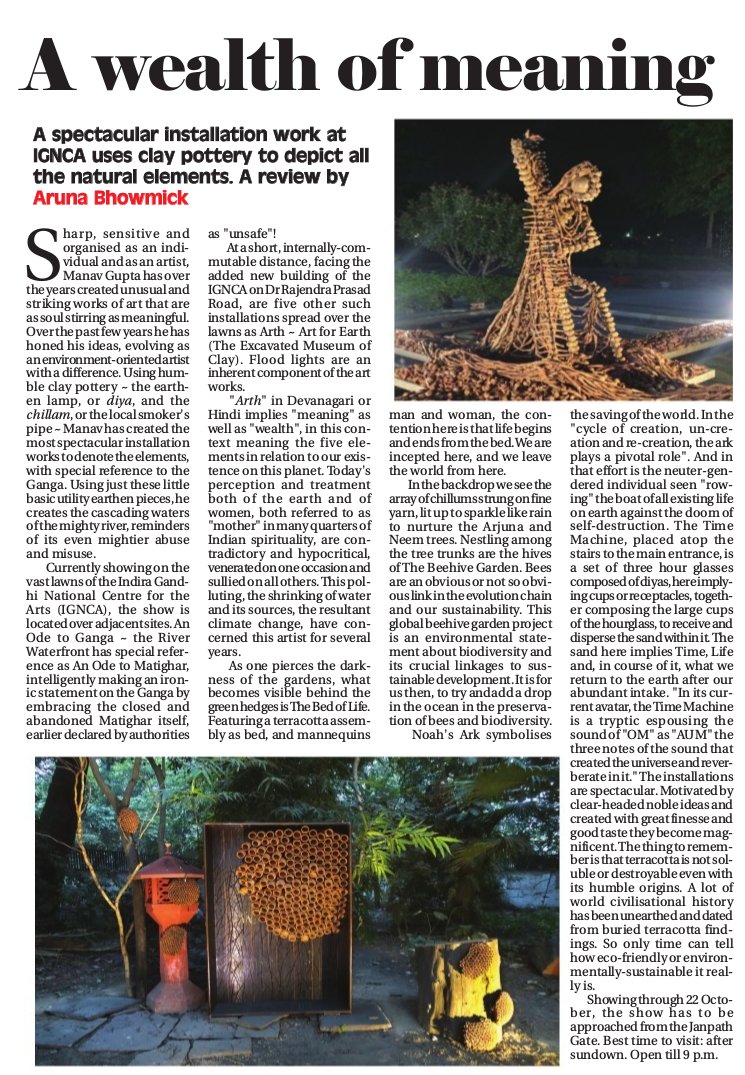
July 19, 2018 | The Statesman | A wealth of meaning | Aruna Bhowmik
Currently showing on the vast lawns of the Indira Gandhi National Centre for arts (IGNCA) the show is located over adjacent sites. An -Ode to Ganga – Waterfront has special reference as An Ode to Matighar, intelligently making an ironic statement on the Ganga by embracing the closed and abandoned Matighar itself, earlier declared by authorities as “unsafe.” At a short internally commutable distance, facing the new building of IGNCA. On Dr. Rajendra Prasad Road, are five other such installations spread over the lawns as Arth ~ Art for Earth (The Excavated Museum of Clay). Flood lights are an inherent component of the art works.
“arth” in Devanagari or Hindi implies “meaning’ as well as “wealth”, in this con- text meaning the five elements in relation to our existence on this planet. Today’s perception and treatment both of the earth and of women, both referred to as “mother” in many quarters of Indian spirituality, are contradictory and hypocritical, venerated on one occasion and sullied on all others. This polluting, the shrinking of water and its sources, the resultant climate change, have concerned this artist for several years.
As one pierces the darkness of the gardens becomes behind the Featuring a terracotta assembly as bed, and mannequins man and woman, the contention here is that life begins and ends from the bed. We are incepted here, and we leave the world from here.
In the backdrop we see the array of chillum strung on fine yarn, lit up to sparkle like rain to nurture the Arjuna and Neem trees. Nestling among the tree trunks are the hives of The Beehive Garden. Bees are an obvious or not so obvious linking the evolution chain and our sustainability. This global beehive garden project is an environmental statement about biodiversity and its crucial linkages to sustainable development. It is for us then, to try and add a drop in the ocean in the preservation of bees and biodiversity.
Noah’s Ark symbolises the saving of the world. In the “cycle of creation, un-creation and re-creation, the ark plays a pivotal role”. And in that effort is the neuter-gendered individual seen “rowing” the boat of all existing life on earth against the doom of self-destruction. The Time Machine, placed atop the stairs to the main entrance, is a set of three hour glasses composed of diyas, here implying cups or receptacles, together composing the large cups of the hourglass, to receive and disperse the sand within it. The sand here implies Time, Life and, in course of it, what we return to the earth after our abundant intake. “In its cur- rent avatar, the Time Machine is a tryptic espousing the sound of “OM” as “AUM” the three notes of the sound that crated the universe and reverberate in it.”
The installations are spectacular. Motivated by clear-headed noble ideas and created with great finesse and good taste they become magnificent. The thing to remember is that terracotta is not soluble or destroyable even with its humble origins. A lot of world civilisational history has been unearthed and dated from buried terracotta findings. So only time can tell how eco-friendly or environ- mentally-sustainable it really is.
Showing through 22 October, the show has to be approached from the Janpath Gate. Best time to visit: after sundown. Open till 9 p.m.